Garth Allen Fence Builders: fence company in Allen, TX, built for Blackland clay

Cedar privacy fences on steel posts, iron, gates and pool barriers for Allen yards. The ground here is Houston Black clay that swells when it rains and shrinks in August, so the posts, footings and gates are planned for movement before the first hole is dug.

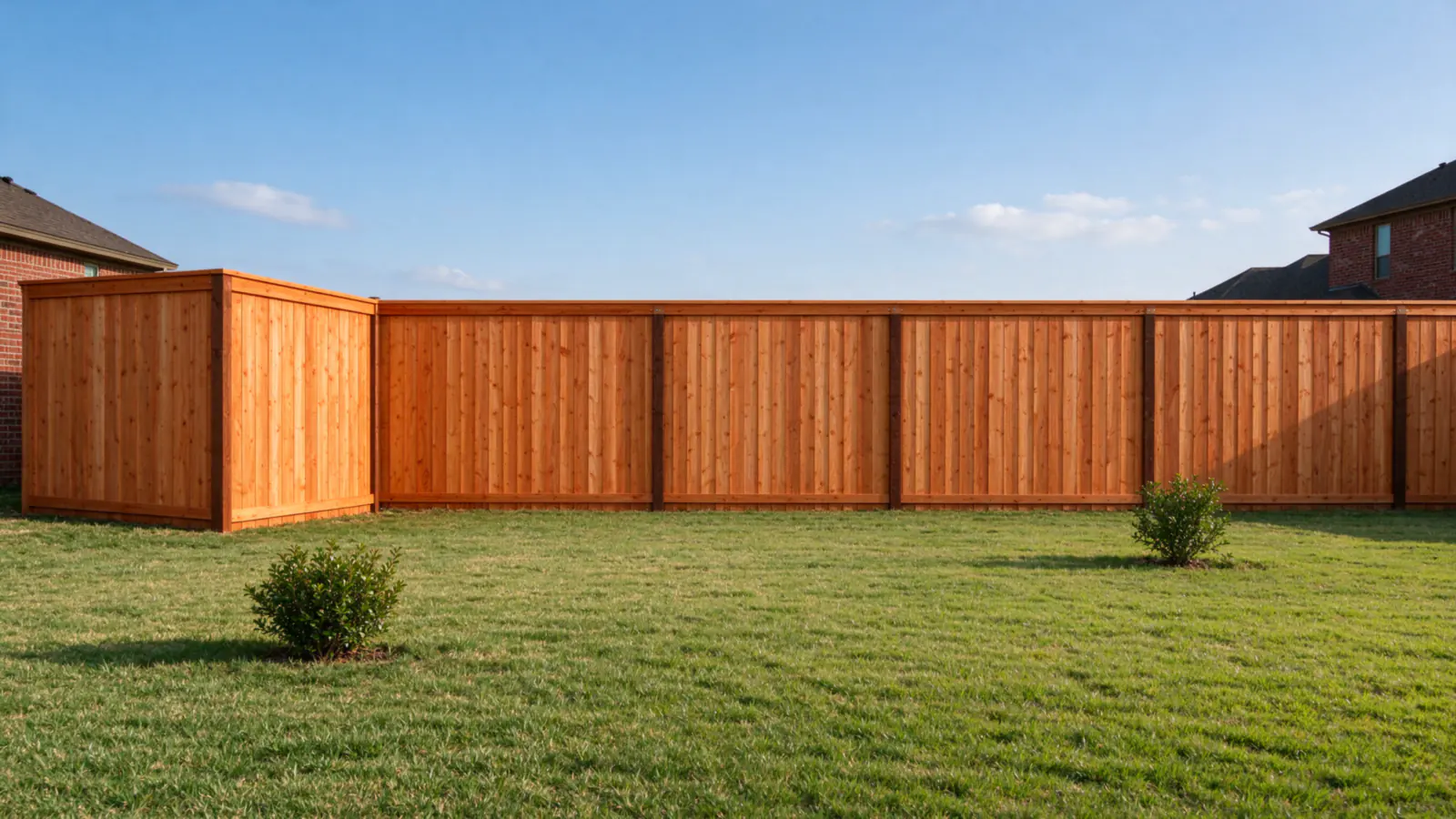
Newly built 6 ft cedar board-on-board privacy fence with a cap rail along a flat Allen, Texas backyard under open blue sky

(945) 203-4292

Get an Estimate

What usually starts the call

Most Allen fence projects begin with one of four moments. Each one points to a different first step.

The fence is leaning after a wet spring

Clay that swelled around the footings and then dried can rock a post loose. One or two leaning posts is a repair; a whole run moving together usually means the footings were too shallow for the soil.

Fence repair

A storm took a section down

A solid 6 ft privacy fence catches wind like a sail, and Allen's building code designs for 105 mph gusts. Photograph the damage, check the posts at grade, and keep the broken boards for the insurance adjuster.

After a storm

The old cedar is gray, split and loose

Boards that cup and split while the posts still stand can often be re-boarded on the existing steel. Rotted wood posts, or a fence that leans along its whole length, point toward replacement.

Fence replacement

A new pool, a new dog or a sale coming up

A pool needs a 4 ft barrier with self-closing, self-latching gates before it passes inspection. A dog that digs or jumps changes the bottom detail and the height. A listing photo changes how much the street side matters.

Pool fences
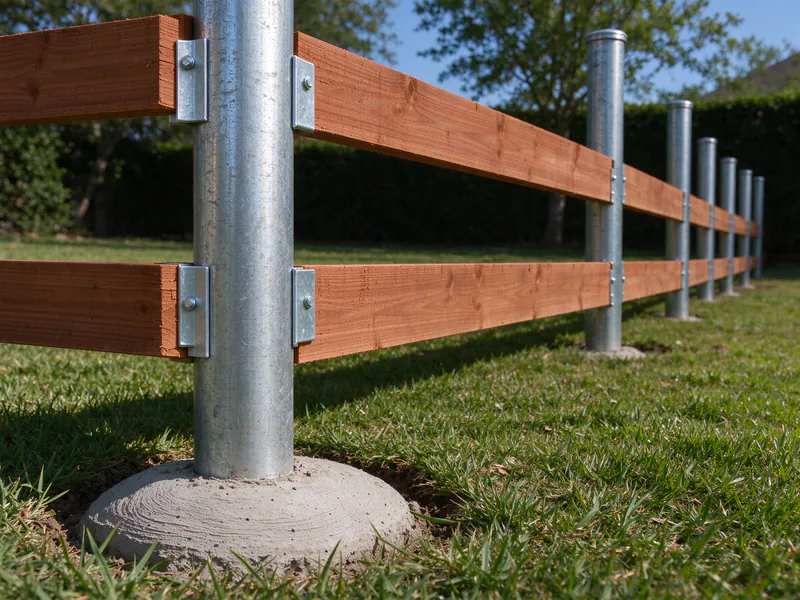
Galvanized steel fence post set in crowned concrete with cedar rails attached by steel post brackets before pickets go on

Wood and privacy fences

Cedar privacy fences on steel posts

Garth Allen Fence Builders installs cedar privacy fences across Allen, and in Allen that means cedar boards on steel posts. The City of Allen fence guideline requires metal posts on all fencing, with metal caps and hardware, so the familiar all-wood fence is not an option here.

What the work includes

The job starts with the line: utilities located through Texas811, sprinkler heads and drainage easements marked, and the corners and gate openings staked. Galvanized steel posts are then set at least 18 inches into concrete, deeper for 8 ft fences and gate posts, with the concrete crowned so water runs away from the steel. Rails are bolted to the posts with brackets, and cedar pickets go on with exterior-rated fasteners. Most Allen privacy fences are 6 ft, and the city allows up to 8 ft in back and side yards. A top cap and trim board protect the end grain and give the street side a finished edge.

Wood fence installation

What changes the plan

Slope decides whether panels step down in level sections or rack to follow the grade; board-on-board can rack, framed panels usually step. Along the 3-ft drainage easement on most Allen lot lines the bottom board stays at least 3 inches above finished grade, so a buried rot board is out on that stretch. Gate openings need heavier posts than line posts. Corner and alley lots have to keep clear sight lines at intersections. An HOA may set the style, the height or the stain color, and its approval comes before the City permit.

Steel posts or wood posts

Galvanized steel posts don't rot at the ground line and don't feed termites, which matters in a city whose building code rates termite pressure 'Very Heavy'. Wood posts are cheaper and easier to cut, but a wood post sitting in wet Houston Black clay is where older fences in the area failed first. Since Allen requires metal posts, the real choice is how the steel is finished: brackets hidden behind the boards, round posts with rail clamps, or a cedar wrap around each post for a wood look from both sides.

Steel vs wood fence posts

Board-on-board or side-by-side

Side-by-side pickets butt edge to edge, and as cedar dries each board shrinks a little, so thin gaps open within a season. Board-on-board overlaps a second layer so the gaps stay covered and the fence looks the same from both sides. It uses roughly a third more pickets, which is why it typically runs $35 to $50 a foot installed in the DFW area against $18 to $35 for side-by-side. Shadow box spaces the layers apart for airflow, at the cost of some privacy.

Board-on-board vs side-by-side

Where vinyl fits in Allen

Vinyl is not on the City of Allen's list of accepted fence materials (brick, wood and wrought iron), so a vinyl fence needs the Building Official's approval before a permit is issued. Where it's allowed, vinyl doesn't need staining, but it expands and contracts with Texas heat, can crack on impact, and still has to meet the metal-post rule. With typical DFW-area pricing of $25 to $45 a foot, it lands close to board-on-board cedar. Ask the HOA too, since many Allen subdivisions specify cedar.

Wood vs vinyl in Allen

Replacement and repair

Replacing an aging fence, or fixing the part that failed

Every fence in Allen eventually reaches the point where the question is whether to fix it or start over. The answer depends on what failed: the posts, the boards or the whole line.

Fence replacement: the work

Replacement in Allen starts with a City of Allen fence permit and, in most subdivisions, HOA approval of the style and stain. The old fence comes down section by section, and the posts and their concrete collars are broken out and hauled away so the new footings start in clean holes. Tear-out typically adds $3 to $8 a foot in the DFW area. Where a neighbor shares the fence, the replacement is easier to schedule once both sides have agreed on the line, the height and who pays.

Fence replacement

Fence replacement: what to settle first

The line has to stay on your side: the City guideline says a fence must be on private property and cannot cross the property line at any point, so an old fence that wandered is not a survey. Replacement is also the moment to change what didn't work: a gate moved off a low spot, a section raised to 8 ft against a two-story neighbor, steel posts in place of rotted wood, or a wider gate for a trailer. If the old fence crossed a drainage easement, the new one keeps the 3-inch gap at the bottom.

Fence repair: the work

Repair covers the parts that fail first: a post rocking in clay, a rail split at the bracket, storm-broken pickets, a gate that drags. A leaning steel post usually needs a new, deeper footing rather than a collar of concrete poured around the old one, which only adds weight to a footing that is already moving. Broken pickets are matched in width and thickness and fastened to the existing rails, and a cracked rail is replaced between brackets. Loose hardware is replaced with exterior-rated fasteners, and a post that has rusted through at the concrete is cut out and reset rather than patched. A gate that drags is usually a hinge-post problem and is fixed at the post.

Fence repair

Fence repair: when it makes sense

Isolated damage on a sound fence is worth repairing: a few loose posts, a section a tree limb broke, a gate that needs a new hinge post. When the boards on a whole run are cupped and gray-black at the bottom and the posts move together, the repair money starts going into a fence near the end of its life. New cedar beside old will look brighter until it weathers, and a stain over the whole run evens it out. Repairing a few sections of a shared fence is also simpler to agree with a neighbor than a full replacement.

Deciding between the two

Three checks settle most cases. Push each post at shoulder height: a few loose posts is repair, half the line is replacement. Look at the boards behind the sprinkler spray: soft, dark wood at the bottom means water damage that spreads. Count how many sections a storm or a neighbor's tree damaged. When repairs would touch a large share of the line, the money usually goes further on a replacement, and a permit may be needed either way. A shared fence also needs the neighbor's agreement before either.

Repair or replace

How long cedar lasts here

Cedar resists decay better than plain pine, but in Allen it fights three things: ground moisture, sprinkler spray and termites in a city whose code rates the risk 'Very Heavy'. Taking the posts out of the equation with steel is the biggest gain. After that, boards kept off the soil, a stain renewed before the wood grays, and sprinklers aimed away from the fence decide how long the pickets stay straight. A fence that gets all three right outlasts one that gets none.

How long cedar lasts

Why plan an Allen fence this way

Rules first

Allen's metal-post rule, 18-inch footings, 3-inch drainage gap and alley gate layouts shape the design before a price is written.

Built for clay

Footings and gate posts are sized for Houston Black clay, which NRCS rates very high for shrink-swell.

Prices you can check

Typical DFW-area ranges are published here, with what moves them, so a quote can be read line by line.

How an Allen fence project usually runs

  1. First call

    The line, the height, gates, slope, the dog, the pool, the HOA. Photos help.

  2. On the property

    The line is measured, drainage easements and sprinkler heads noted, and the material and gate plan settled.

  3. Permit and HOA

    HOA approval first where it applies, then the City of Allen permit and Texas811 locates.

  4. Build day

    Old fence out, posts set in concrete, rails and boards up, gates hung and adjusted.

  5. Finished

    Gates tested, debris hauled off, and the city inspection where the permit calls for one.

Walking the fence line this week?

Send a photo of the run and the gate, or call. Getting the measurements right is the first step to an accurate price.

Gates and automatic gates

Gates that close square, and alley gates that meet the city's rules

A gate is the one part of a fence that moves every day, so it gets heavier posts, deeper footings and hardware sized to its weight. Garth Allen Fence Builders installs walk gates, double drive gates and automatic gates in Allen and nearby cities.

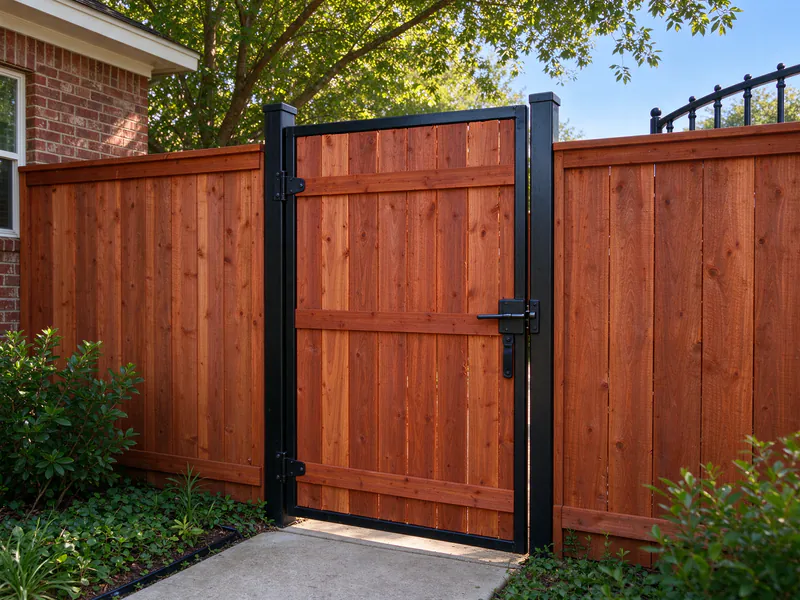
Cedar walk gate in a black steel frame hung between black steel posts in a side-yard fence

Gate installation: the work

Walk gates for side yards, double gates wide enough for a mower or a trailer, and drive gates across alley-loaded garages. The hinge post carries the gate's full weight and swing load, so it is set deeper and heavier than a line post, and wide wood gates get a steel frame or a diagonal brace in compression from the bottom hinge corner. Hinges, latches, drop rods and stops are sized to the gate, and the swing is checked against the slope so the bottom clears the ground through its full arc.

Gate installation

Gate installation: sizes and prices

The clear opening is what matters, not the panel width: a 10 ft double gate leaves less than 10 ft between the posts once hinges and the latch gap are counted. Measure the widest thing that has to pass, then add room to turn into it. Typical DFW-area pricing runs $150 to $600 for a walk gate and $400 to $900 for a double drive gate, with steel frames, wider spans and decorative tops at the high end.

Why gates sag

Most sagging comes from the hinge post leaning, not the hinges wearing out. In clay soil a post set too shallow tips a little toward the gate every wet season, and the latch side drops. Tightening screws hides it for a month. The lasting fix is a deeper footing on the hinge side, a brace running from the bottom hinge corner up to the latch side, or a steel gate frame that doesn't rack. A gate wheel can carry a wide gate's latch end, but it hides the real problem if the post is leaning.

Why gates sag

Swing or sliding across an alley

Many Allen homes load from an alley, and a gate across that driveway has to swing clear of the slope or slide along the fence line. A sliding gate needs runback space about as long as the opening, beside the drive. The City of Allen fence guideline adds one more step: a sliding gate across a rear-entry driveway must follow one of two city trash-bin layouts, with the bin pad outside the gate, and the permit application must name which one.

Swing vs sliding gates

Automatic gates: the work

Adding an operator turns a gate into a machine. Automatic gate installation covers the operator itself, the power run from the house or a pedestal, photo eyes and contact edges, and a gate built straight and light enough for the motor to move without strain. Swing operators mount to the hinge post; slide operators sit on a pad beside the track. Keypads, remotes and phone access come with the operator. The finished system is tested with the gate's own sensors: the gate is run against an obstruction and must stop and reverse, and the photo eyes are checked across the full opening before it is handed over. Manual release is shown so the gate can be opened in a power outage.

Automatic gate installation

Automatic gates: what decides the setup

The gate's weight and length pick the operator. Slope can rule out a swing gate entirely, and an alley drive in Allen also has to keep the trash-bin layout clear. The electrical run is planned before posts go in so conduit isn't trenched through a finished yard. Typical DFW-area pricing for an automatic gate with its opener runs $1,500 to $4,000, with longer runs, heavy steel gates and access systems at the top. Solar-powered operators exist for gates far from the house, but they suit light, low-traffic gates best.

Safety on automatic gates

Gate operators are covered by UL 325, and the gates they move by ASTM F2200. In practice that means entrapment protection at every point where a moving gate meets a post or wall, monitored photo eyes or contact edges, and guards over rollers and openings a hand could reach. A gate that stops and reverses when it touches something is the minimum, not an upgrade, and old operators without monitored sensors are worth replacing. Children and pets near a moving gate are the reason these standards exist.

Automatic gate safety
Iron, pool and commercial

Wrought iron, pool barriers and commercial fencing

Wrought iron is one of the three fence materials the City of Allen accepts by name, and it does jobs a privacy fence can't: open lines, pool enclosures and property edges where a view matters.

Iron fences: the work

Most residential 'wrought iron' today is welded tubular steel or aluminum, powder-coated or painted. Panels are set between posts in concrete, racked or stepped to follow the grade, and gates are hung on heavier posts with self-closing hinges where a pool is involved. Steel is stiffer and heavier and can be welded into custom designs; aluminum does not rust and is lighter to move. Typical DFW-area pricing runs about $28 to $55 a foot installed, with custom welded work higher.

Iron fence installation

Iron fences: what to decide

Picket spacing and the bottom gap matter when the fence has to hold a small dog or form part of a pool barrier. Finish decides upkeep: powder coat lasts longest, paint is easiest to touch up. Allen's guideline allows fences in back and side yards, so an iron line toward the street needs a check with the city first. An HOA may also set the color and picket style for anything visible from the street. Black is the usual color, but bronze and other powder-coat colors are common.

Rust on older iron

Rust on an Allen iron fence usually starts where water sits: post bases in sprinkler spray, the bottom rail and the welds. Surface rust can be wire-brushed, primed and repainted. Rust that has eaten through a post at the concrete or split a weld means cutting out that post or section and welding in new steel, then coating the whole run so the repair doesn't stand out. Moving sprinkler heads so they stop spraying the iron slows the next round of rust more than any coating.

Rusted iron fence repair

Pool fences: the rules

Under the City of Allen's rules a pool or hot tub must be fully enclosed by a fence or wall at least 4 ft high. Gates must be self-closing and self-latching, and the latch sits on the pool side at least 4.5 ft above the ground. House doors that open into the pool area need alarms. The pool permit and its barrier inspection are part of getting a new pool approved. An existing fence that forms part of the barrier has to meet the same rules, including the gate hardware.

Pool fence installation

Pool fences: the build

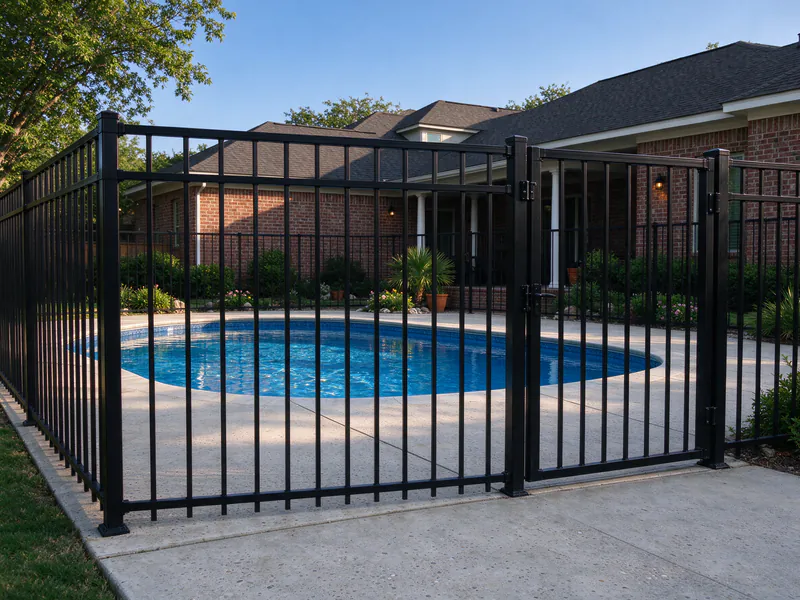
Iron and aluminum suit pool lines because they keep the water visible from the house. The barrier is planned around the gaps a child could climb or squeeze through: no horizontal rails on the outside to use as a ladder, and a bottom gap held tight. Gates swing away from the pool and close on their own every time, so hinge tension and latch alignment are checked on the finished gate. An existing privacy fence can form part of the barrier if it meets the same height and gate rules. Above-ground pools and spas follow their own barrier details, which are confirmed per address. Gate hinges are adjusted so the gate closes from any open position, not just from wide open.

Commercial fencing: the work

Commercial work brings chain link, security fencing and ornamental steel for storefronts, detention ponds, equipment yards and property lines. Chain link isn't on Allen's residential material list but is common on commercial sites. Framework gauge, fabric gauge, coating and height decide how long it lasts, and tension wire or a bottom rail keeps the fabric tight. Typical DFW-area chain link pricing runs $12 to $30 a foot. Ornamental steel is common along storefronts and entrances, where a chain link line would look out of place, and both can run along the same property.

Commercial fencing

Commercial fencing: what's different

Schedules, site access and documentation matter more on commercial jobs. Work is planned around business hours and deliveries, gates are sized for trucks and emergency access, and the property owner or manager signs off on the line before posts go in. Privacy slats, barbed wire arms and access-controlled gates are decided at the start, since each changes the posts and footings. Larger sites often need a written scope, insurance certificates and coordination with other trades, and the line may cross easements that need the city engineer's sign-off before work starts. Repairs on commercial lines are often urgent after a vehicle strike, and temporary panels can hold a site while posts are reset.

Black ornamental steel pool fence with a self-closing gate around a backyard pool

Typical Allen fence prices, per foot installed

Typical DFW-area budgeting ranges for 6 ft fences, before gates and tear-out. A real price comes from the measured line.

FenceTypical rangeWhat it coversWhat moves it
Cedar board-on-board, steel posts$35–$50 / ftPosts in concrete, rails, overlapping cedar picketsTop cap and trim, 8 ft height (adds 25–40%), slope
Cedar side-by-side, steel posts$18–$35 / ftSingle layer of cedar picketsPicket grade, height, access along the line
Wrought iron or ornamental steel$28–$55 / ftStandard panels and postsCustom welding, pool-rated panels, grade changes
Chain link$12–$30 / ftFabric, framework, postsGauge, coating, privacy slats, height

Ranges are typical budgeting figures for Dallas-Fort Worth area projects, not quotes. The City of Allen permit fee is from the City's published fee schedule.

What to know before an Allen fence goes in

The questions behind most Allen fence projects, with the local figure that settles each one.

Cost and timing

What an Allen fence costs

For a typical 150 ft backyard in 6 ft cedar board-on-board on steel posts, the per-foot range above works out to roughly $5,250 to $7,500 before gates, tear-out and the $75 permit. Length and height move the number most, then style: board-on-board uses about a third more pickets than side-by-side. Corner lots, slopes, 8 ft sections and a drive gate across the alley each add their own line. Comparing quotes is easier when each one lists the same items: footage, height, style, posts, gates, tear-out and the permit.

Fence cost in Allen

How long the project takes

The build itself is the short part. Most backyard runs are set, boarded and hung in a few days on site once materials are in and the line is marked. HOA review and the City of Allen permit, which goes through the city's online Citizen Self-Service portal, usually take longer than the construction. Posts set in concrete need time before gates take full weight, and rain on clay can push digging back a day or two. Ordering and delivery can add days in busy seasons.

How long installation takes

Allen's fence rules

Permits, heights and easements

Allen requires a permit for fences, applied for online through the city's Citizen Self-Service portal, with a $75 fee. Fences are allowed in back and side yards up to 8 ft, measured from the adjacent grade. Along the standard 3-ft lot-line drainage easement the bottom must clear grade by 3 inches, fences are not allowed in floodplains, and drivers' sight lines must stay clear 20 ft back from alley corners. The city asks owners to check with their HOA before applying.

Allen fence permit rules

Property lines and shared fences

The City of Allen guideline says a fence must sit on private property and cannot cross the property line at any point. An old fence is not proof of where the line is: builders sometimes set them inside or across it. A survey or the recorded plat shows the line, and the property pins in the corners are worth finding before posts go in. Who pays for a fence two neighbors share is settled between them, and sometimes by HOA documents, so put any split in writing before work starts.

Property lines and shared fences

Clay, wind and weather

Posts in Houston Black clay

Federal soil surveys map Houston Black clay across most of Collin County, with linear extensibility up to 12 percent, well above the 9 percent mark where NRCS rates shrink-swell as very high. Wet clay swells against a footing and lifts it; dry clay cracks away and leaves it loose. Allen's 18-inch minimum is a floor. Taller fences and gate posts go deeper, holes are kept straight-sided or belled at the bottom so the clay can't grip a mushroomed top, and concrete is crowned to shed water.

Fence posts in clay soil

After a storm

Allen's building code designs for 105 mph gusts, and a solid privacy fence takes the full force of the wind. After a storm, photograph each damaged section and the posts at ground level before anything is moved, note whether a neighbor's tree or your own fell on the fence, and check whether the fence is shared. Snapped pickets are quick to replace; posts lifted out of the ground mean the footings need work. Keep the broken boards until an adjuster has seen them.

Storm-damaged fence

Warping, splitting and graying

Cedar grays within a season of sun because ultraviolet light breaks down the surface fibers. Boards cup when one face gets wet and the other doesn't, which is why the side facing the sprinklers warps first. Splits start at nails driven too close to the board end, or where a dry board was fastened too tight to move. Black streaks are usually mildew on wet wood, and green film is algae where shade and spray meet. None of these alone means the fence is failing.

Warping and splitting

Staining and care

Fence staining: why it matters

Garth Allen Fence Builders also stains and seals cedar fences in Allen. Stain slows the graying that Texas sun causes, keeps the boards from drying out and cracking as fast, and evens out mixed old and new boards after a repair. Staining is not a repair: it cannot straighten cupped boards or bring rotted wood back. Mixed old and new boards after a repair are the most common reason to stain a fence that is otherwise in good shape, and a fresh coat before the wood grays saves a cleaning step.

Fence staining: the work

The work starts with cleaning off mildew and gray surface fibers so the stain reaches sound wood, then letting the boards dry. A penetrating semi-transparent stain is sprayed and back-brushed into the grain, which holds up better than a film that peels. Plants, the house and the neighbor's side are covered, and windy days are skipped. Typical DFW-area pricing runs $3.50 to $7 a foot for one side. Staining both sides costs more and needs the neighbor's access or agreement. In Texas sun, a semi-transparent stain on a privacy fence usually needs renewing every few years, sooner on the sunny side. Fresh cedar should be dry enough to absorb water before the first coat.

Fence staining

When to stain new cedar

New cedar needs to dry before stain will soak in. A quick check: sprinkle water on a board, and if it beads up, wait; if it soaks in within a few minutes, the wood is ready. In an Allen summer that can happen within weeks; after a wet spring it takes longer. Waiting too long has a cost too, because once the surface grays it has to be cleaned before staining. A dry, mild stretch without rain in the forecast is the best window.

When to stain a new cedar fence

Dogs and kids

Fences for dogs

Diggers and jumpers need different fences. For diggers, a kickboard or buried wire along the bottom stops most escapes, but along Allen's 3-ft drainage easement the bottom has to clear grade by 3 inches, so the dig barrier goes on the inside face instead of under the fence. For jumpers, height matters more than style, and Allen allows up to 8 ft in back and side yards. Owners of reactive dogs report that a solid fence cuts down barking at passers-by.

Best fence for dogs

The decision most Allen owners face

With an older fence, the choice usually comes down to three paths. Here is what each one means.

QuestionRepair sectionsRe-board on existing steelFull replacement
When it fitsA few loose posts or broken pickets on a sound fenceSteel posts plumb and solid, cedar boards worn outPosts leaning along the line, wood posts rotted, or a new layout
What staysEverything not damagedPosts and footingsNothing
PermitCheck with the city for the scopeCheck with the city for the scopeCity of Allen fence permit
What to check firstPush-test every postPost plumb and footing conditionSurvey or plat, HOA rules

Allen and nearby cities

Every city around Allen writes its own fence rules. Here is what changes from one to the next.

AllenPermit required, $75; metal posts; 18 in concrete minimum; 8 ft max in back and side yards
MurphyPost depth by height: 3 ft for 8 ft fences, 2 ft for 6 ft; repair permit for 15 ft or 5 posts
FairviewFence contractors register with the Town; permit and plan review fees; plat required
WylieFence permit required; other rules confirmed per address
McKinney, Plano, LucasRules confirmed per address

All service areas

Allen fence questions

Do I need a permit to build a fence in Allen?

Yes. The City of Allen lists fences among the projects that need a building permit, applied for through its Citizen Self-Service portal. The fee is $75, and the city asks owners to check with their HOA before they apply. Your contractor must also be registered with the city.

Can I use wood posts in Allen?

No. The City of Allen fence guideline requires metal posts on all fencing, along with metal caps and hardware. Cedar boards and rails are fine; they are mounted to steel posts with brackets, or the steel is wrapped in cedar for a wood look.

How tall can a backyard fence be in Allen?

Up to 8 ft in back and side yards, measured from the adjacent grade. A fence on top of a retaining wall is also limited to 8 ft, and the wall and fence together can't exceed 12 ft.

Why does my new fence have a gap at the bottom?

Most Allen lots have a 3-ft drainage easement along the property line. The city allows a fence there only if the bottom member sits at least 3 inches above finished grade, so storm water can pass under it.

What does a pool fence need in Allen?

A fence or wall at least 4 ft high around the whole pool or hot tub, with gates that close and latch on their own. The latch goes on the pool side at least 4.5 ft above the ground, and house doors opening into the pool area need alarms.

Can a sliding gate go across my alley driveway?

Yes, if it follows one of the City of Allen's two trash-bin layouts, which keep the bin pad outside the gate so collection trucks can reach it. The permit application has to say which layout is used.

Is cedar or iron better for a front yard?

Allen's fence guideline allows fences in back and side yards, so front-yard lines need a check with the city first. Where an open, decorative line is wanted, iron keeps the house visible; cedar is for privacy behind the front of the house.

Start with the fence line

Tell us the length, the height and the gates, or send a photo. The estimate starts from the line on your lot, and the work is carried out by insured fence contractors registered with the City of Allen.

(945) 203-4292

office@garthallenfencebuilders.com

Monday to Friday, 8 AM to 6 PM; Saturday and Sunday, 9 AM to 2 PM. Outside these hours, emergency calls only.

Step 1 of 2

The property and the work
Call (945) 203-4292Get an Estimate