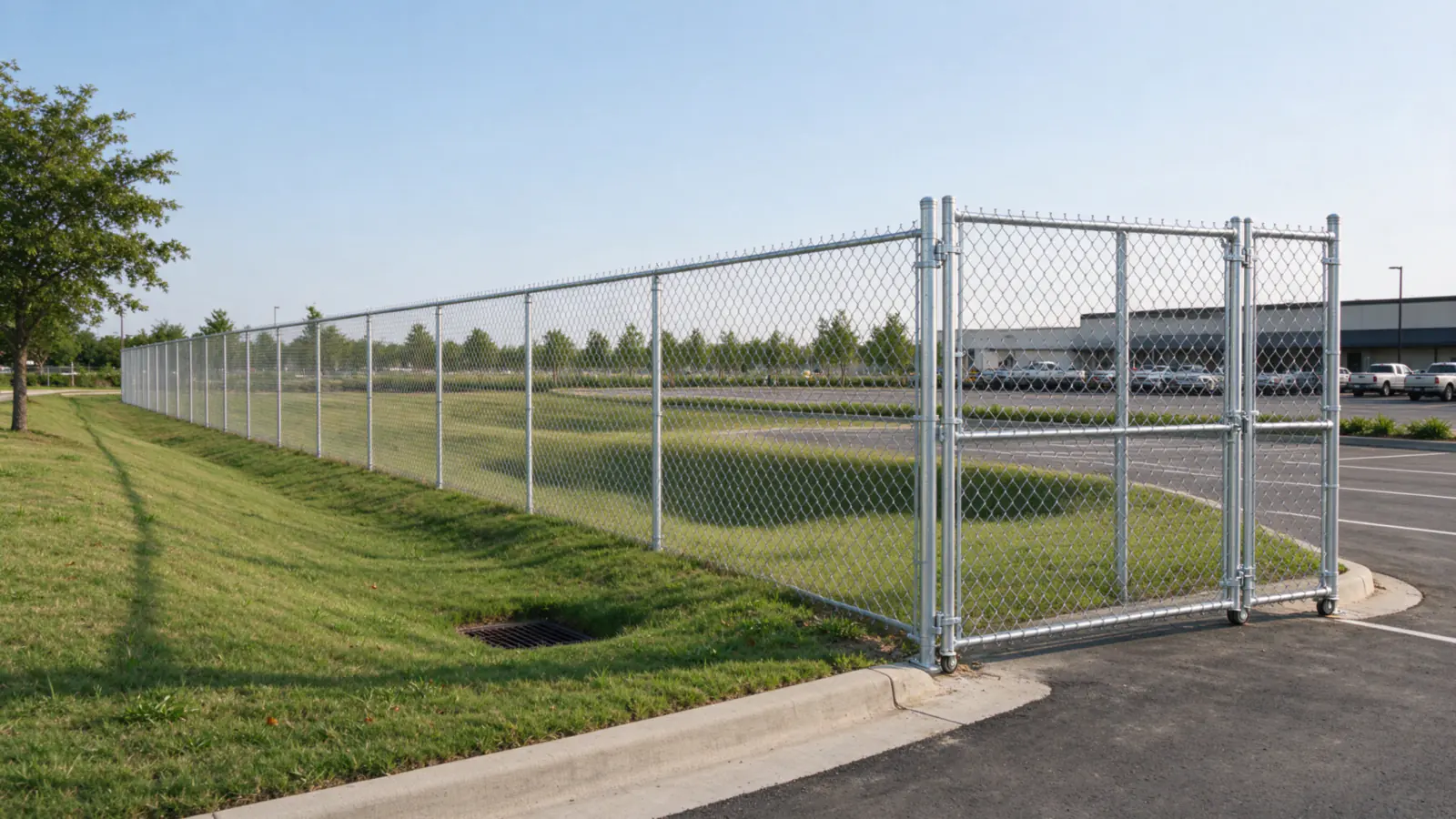
Garth Allen Fence Builders handles commercial fence projects in Allen and nearby Collin County cities: chain link around storage and equipment yards, security fencing for sites that need to be closed off at night, ornamental steel along storefronts and office frontage, and fencing around HOA pools, entries and common areas. The work is carried out by insured fence contractors registered with the City of Allen. Commercial sites bring their own constraints, such as a business that stays open during the work, wider gates, heavier traffic and private utilities underground, and this page sets out how those shape the fence.
Chain link built to stay tight
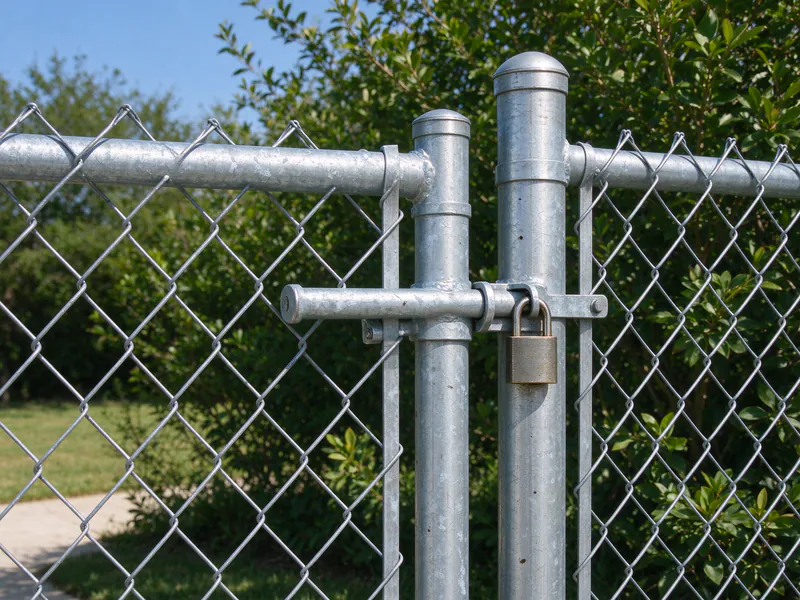
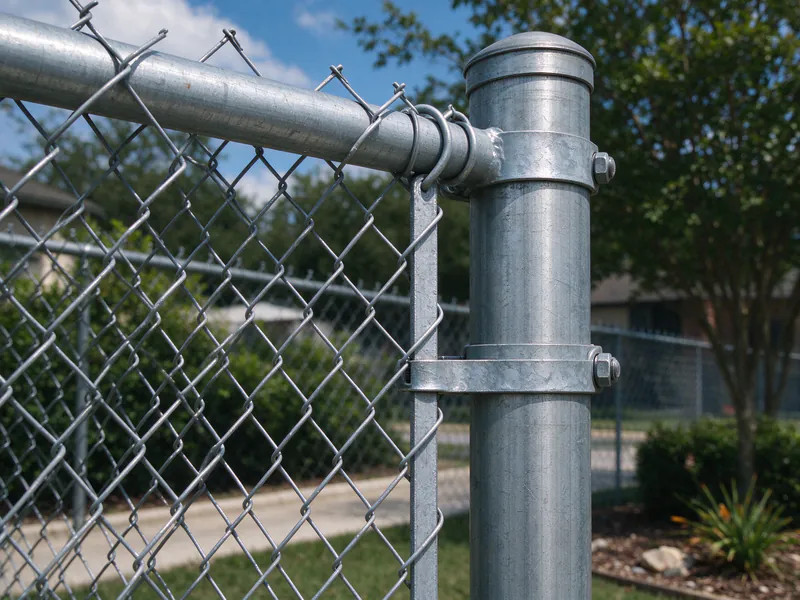
A chain link fence is a framework with fabric stretched over it, and most failures come from the framework. Terminal posts at ends, corners and gates carry the tension of the fabric, so they are heavier than line posts and set in deeper concrete. A top rail ties the posts together and keeps the top of the fabric straight. At the bottom, a tension wire stretched between terminal posts and tied to the fabric holds the bottom edge in line, so it cannot be pushed out or lifted. Tension bars woven through the end of the fabric and clamped to terminal posts with tension bands spread the pull evenly.
Fabric is chosen by gauge and coating. Heavier gauge wire resists cutting and impact; galvanized fabric is the standard; vinyl-coated fabric in black or green costs more but looks tidier along a street and reflects less glare. In Houston Black clay, the very high shrink-swell soil under most of Collin County, terminal and gate posts get extra depth in straight-sided holes so the clay cannot lift them. The clay soil guide explains why hole shape matters.
Privacy slats and wind
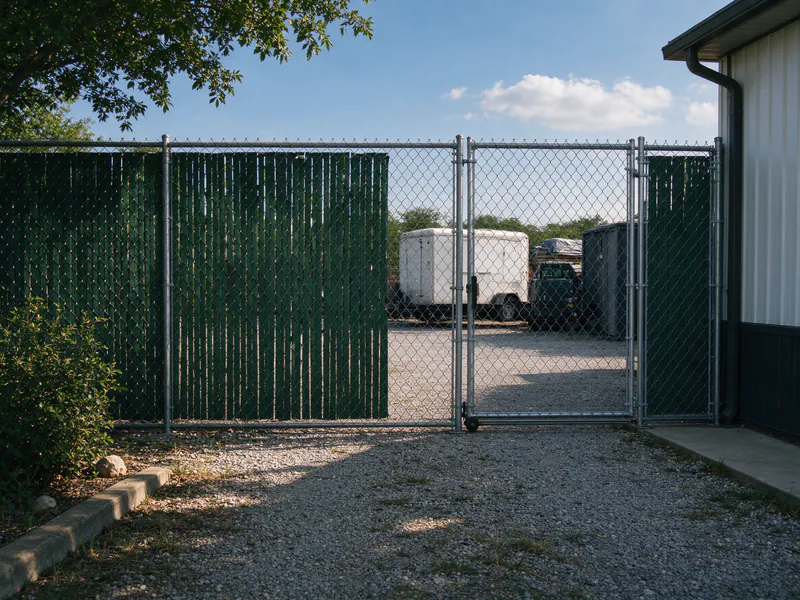
Slats woven into chain link hide a storage yard or equipment from the street, but they change the engineering. Open fabric lets wind through; slatted fabric acts as a nearly solid panel. Allen’s residential code designs houses for 105 mph gusts, and a slatted fence on an open commercial lot sees that same weather with nothing to shelter it. Slatted runs need heavier posts, closer spacing or deeper footings, or the line leans after the first big storm. Where a solid screen is the goal, it is worth weighing that against the extra post work, and the storm damage guide shows what wind does to a fence that was built too light.
Security fencing
A security fence is judged by how hard it is to get over, under and through, and how well the gate holds up. Height deters climbing, and a tight bottom edge, either a tension wire or fabric set close to the ground, stops crawling under. The gate is usually the weak point: a padlocked chain on a sagging gate defeats a well-built line. Gates on secure sites get heavy frames, solid hinge posts and locking hardware sized to the gate.
Toppings such as barbed wire are restricted in some local codes; neighboring Murphy, for example, prohibits barbed and razor wire in its fence code. Each city writes its own rules, so any topping is confirmed with the City before it is specified. Clear sight lines also matter. Allen keeps vision clear at driveways, alleys and street intersections, so fencing at a commercial entrance has to leave drivers able to see traffic.
Ornamental steel for frontage and common areas
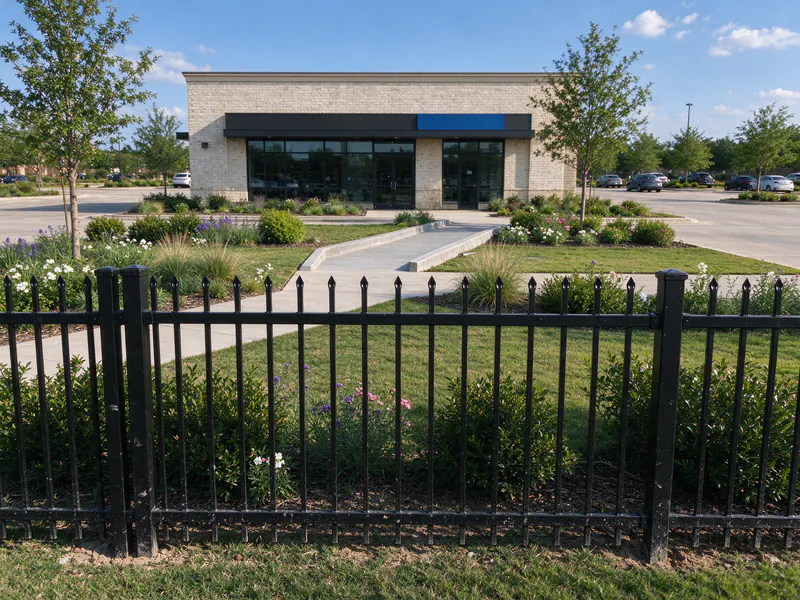
Where a fence faces customers or residents, ornamental steel usually replaces chain link: storefronts, office frontage, apartment and HOA pool areas, and subdivision entries. It reads as a finished boundary while still letting people see through it. Panels mount to steel posts set in concrete, and on sloped sites they rack or step to follow the grade. Fences around a shared pool also have to meet the barrier rules for gates and latches, covered under pool fences. Finish wears first where water sits, at welds and near the ground, and the rusted iron fence guide covers what to watch for. Iron fence installation describes the residential side of the same work.
Gates that handle traffic
Commercial gates open more often and wider than residential ones. A cantilever slide gate hangs on rollers mounted to posts beside the opening and never touches the ground, which suits gravel yards where a ground track would clog. Swing gates need a clear arc and solid hinge posts; double swing gates suit wide openings with room to open inward. The swing vs sliding gate guide compares the two.
Automated commercial gates use the same safety standards as residential ones, UL 325 for the operator and ASTM F2200 for the gate, with entrapment protection at every pinch point. Access control is planned around who comes and goes: keypads, card or phone access, and exit sensors for vehicles. Automatic gate installation and the automatic gate safety guide cover the operator side, and gate installation covers manual gates.
Working on a site that stays open
Most commercial fencing happens around a working business, so the plan covers when the old fence comes out, how the site stays secure overnight while a line is open, and where trucks and customers can pass. In Allen, construction is allowed from 7 a.m. to 10 p.m. seven days a week, which leaves room to schedule noisy work outside busy hours. Contractors register with the City each year for a $50 fee. Before any hole is dug, Texas811 marks the public utilities, but commercial sites often have private lines for parking lot lighting, irrigation, data and signs that 811 does not mark, so those are located separately.
Repairs on a busy site
Commercial fences take hits that backyard fences rarely do: a truck backing into a corner post, a forklift catching the fabric, a storm folding a slatted run. Chain link is forgiving here. A bent top rail section can be cut out and sleeved, damaged fabric can be unrolled and spliced to the good fabric on each side, and a broken terminal post can be reset without rebuilding the whole line. The repair is matched to the existing gauge and coating so it does not stand out. Where damage keeps happening at the same spot, a bollard or a moved gate is often a better fix than repeated patching. Fence repair covers this kind of work.
What commercial fencing costs
Typical DFW-area budgeting runs about $12 to $30 a foot installed for chain link and $28 to $55 a foot for ornamental steel. Removing an old fence typically adds $3 to $8 a foot. Height, fabric gauge and coating, slats, the number and type of gates, automation, and site access decide where a project lands. The fence cost estimator gives a starting figure, and fence replacement covers taking out an old line before the new one goes in.