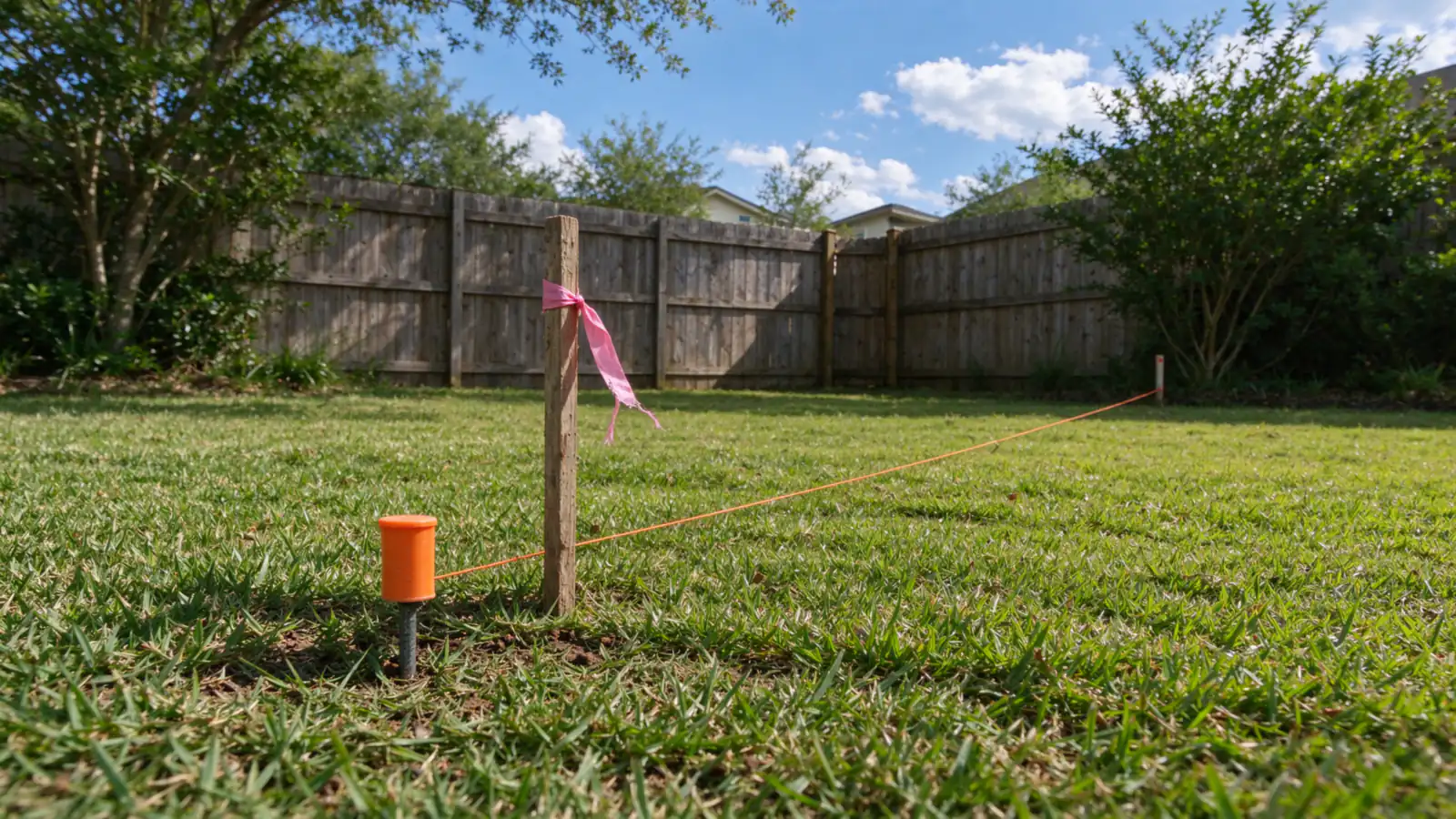
Garth Allen Fence Builders wrote this guide for the planning step most fence projects rush: deciding exactly where the posts go. In Allen the City sets one clear rule, and the rest is about finding the line accurately before anyone digs.
In Allen, a fence must be on private property and cannot exceed the property line, under the City’s Residential Fence Guideline. So a new fence is built just inside your line, not straddling it. Find that line from the corner pins and the recorded plat, or from a survey if pins are missing or the line is disputed.
What Allen’s guideline says
The City of Allen Residential Fence Guideline is direct: fences must be on private property and cannot exceed property lines. Other rules in the same guideline can still push the fence inward or shape its bottom edge in places:
- Corner and alley sight lines. Where an alley meets a street, the guideline requires a clear vision area 20 ft back from the projected curb line, and 200 ft of sight distance at street intersections.
- Drainage easements. In the standard 3 ft lot-line drainage easement, a fence is allowed if its bottom clears finished grade by at least 3 in.
- Other easements and floodplain. Fences in other easements need the Engineering Department’s permission, and none are allowed in floodplain areas.
The full set of rules is in the Allen permit rules guide.
Why the old fence is not the line
When a fence is replaced, the easy assumption is that the new one goes where the old one stood. That is often close, but it is not proof. Fences get set by eye during construction, shifted around a tree or a slope, nudged during repairs, or built before a later replat. A fence a foot onto the neighbor’s lot can stand for years without anyone noticing, and the replacement is when it gets corrected or repeated.
The working rule is simple: a contractor’s estimate of the line is not a survey. Fence builders can measure from pins and the plat, but they cannot certify where a boundary runs.
Finding the line before posts go in
1. Pull the plat and any survey. The recorded subdivision plat shows lot dimensions and easements. Many owners also have a survey from their purchase in their closing documents.
2. Find the corner pins. Lot corners are usually marked with metal pins or rods set at or just under the surface. A metal detector helps; landscaping and old fence footings sometimes bury or bend them.
3. Compare. If the pins are found and the distances between them match the plat, the fence line can be laid out between them with a string, set just inside your side.
4. Survey if anything is off. Missing or disturbed pins, measurements that do not match, a curved lot line, or a neighbor who disagrees all point to hiring a professional land surveyor to stake the line. On a long run close to the boundary, staking costs far less than moving a finished fence.
5. Call Texas811. The City’s permit FAQ points owners to Texas811 for utility locates before digging. Those marks show buried lines, not property lines.
Footings and the line
The fence face is not the only thing that has to stay on your side. Allen requires posts at least 18 in deep in concrete, and footings on clay lots are often wider than the post. Setting posts a few inches inside the line keeps the concrete collar from crossing it. The clay soil guide explains why those footings are sized the way they are.
Shared fences between neighbors
Many Allen fences divide two backyards, and both owners have an interest in them. Common practical arrangements:
- Talk before the permit. Agree on the line, the style and which face points where. Board-on-board looks the same from both sides, which avoids the “who gets the good side” question.
- Put cost sharing in writing. A short signed note covering the split, the style and the timing prevents later disputes.
- Check the HOA. The City asks owners to clear HOA approval before applying for a permit, and some associations have rules on shared or perimeter fences.
This guide gives practical planning steps, not legal advice. For questions about legal rights, boundary disputes or cost recovery between neighbors, consult a real estate attorney.
Outside Allen
Some neighboring cities write the line paperwork into the permit itself. The Town of Fairview requires a plat with a fence permit submittal, and the City of Murphy asks for two site plans with a survey plat. Details are on the service areas pages, including Murphy and Fairview.
Building it
Once the line is settled, a fence replacement or new wood fence is laid out from the pins and permitted with the City. The work is done by insured fence contractors registered with the City of Allen.