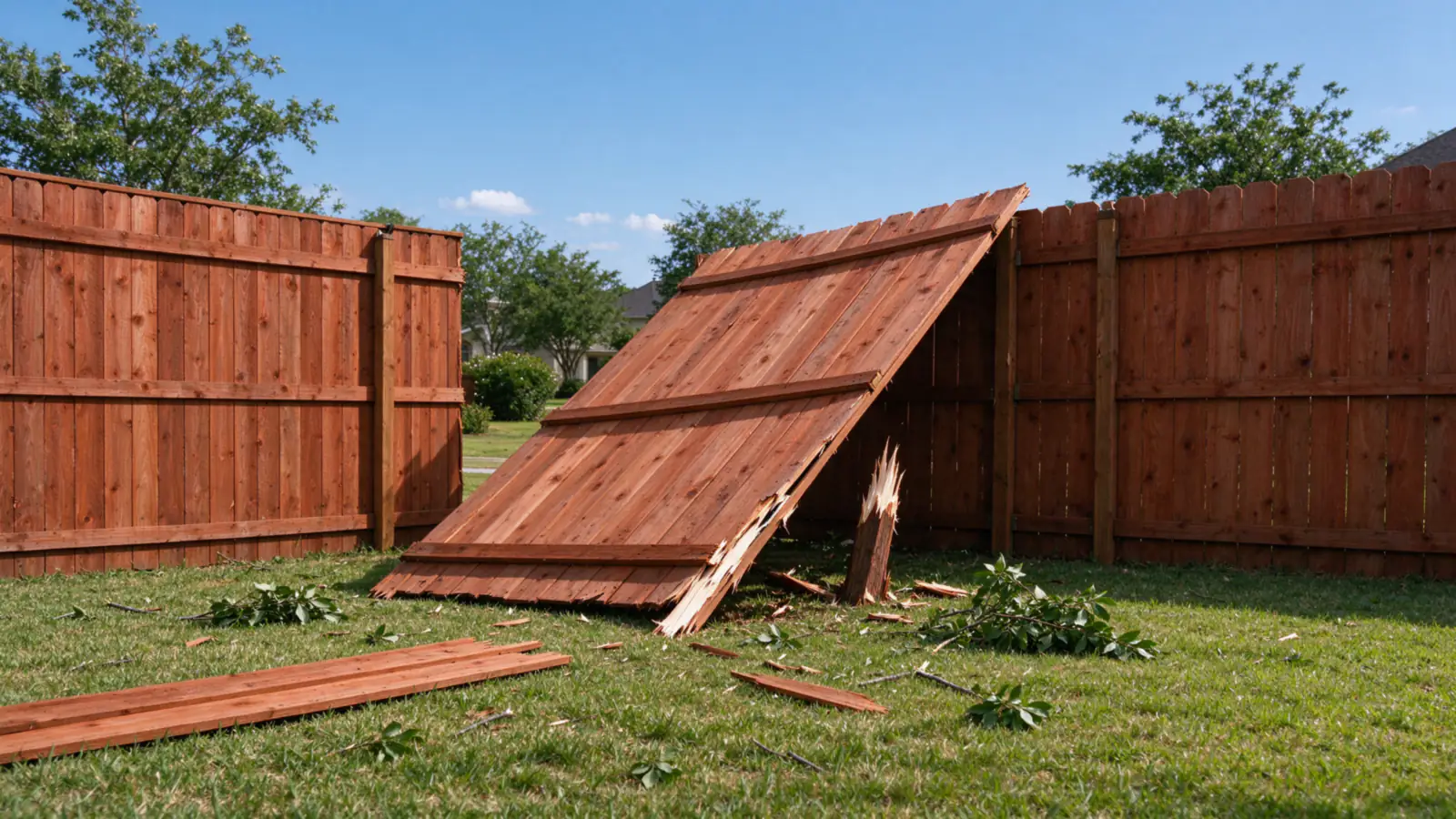
Garth Allen Fence Builders put this checklist together for Allen owners looking at a fence that a storm has leaned, broken or laid flat.
After a storm damages your fence, first make the area safe and secure pets and pools, then photograph everything before moving debris. Work out who owns the fence, check your own policy for coverage rather than assuming it, and have the posts checked: they decide whether it is a repair or a rebuild.
A blown-down fence feels urgent, and some of it is. Most of it can wait a day or two while you get the facts right.
Step 1: Make it safe
Stay clear of any wire in or near the fallen fence and report it to the utility. If the fence enclosed a pool, the barrier is now open: the City of Allen requires pool enclosures at least 4 ft high with self-closing, self-latching gates, so block access with temporary fencing or keep the area supervised until it is restored. Bring dogs in or leash them. Lift fallen panels away from walkways and cars only if they come up easily; leave anything pinned under a tree.
Step 2: Document before you clean up
Records made in the first hours are the most useful later, whether you are talking to an insurer, a neighbor or a contractor.
- Wide photos of the whole damaged run, with the house or a landmark in frame.
- Close photos of each broken or leaning post at ground level, showing whether it snapped, pulled out of its footing or rotted through.
- Cause photos: a fallen limb, a neighbor’s tree, debris that struck the fence.
- Collateral damage to cars, sheds or landscaping.
- A short written note with the date, the storm, and the length of fence affected.
Keep broken pieces until whoever needs to see them has seen them. Whether any of this is covered depends entirely on your policy, its exclusions and deductible, and on what caused the damage; nobody can promise coverage in advance.
Step 3: Work out who owns the fence
On many Allen lots the fence was built by the developer and nobody remembers whose side it sits on. The City guideline requires fences to be on private property and not exceed property lines, so ownership follows the survey, not the fence. If a neighbor’s tree fell on your fence, or the fence sits on the shared line, talk early and keep it in writing. The fence property line guide covers ownership and shared fences in Texas.
Step 4: Read the posts
How the fence failed tells you what to do next.
| What you see | What it usually means | Typical path |
|---|---|---|
| Wood posts snapped at the soil line, dark and soft inside | Rot had already hollowed them; the storm finished them | Replace the run, likely the whole fence |
| Posts pulled out with their concrete | Footings were shallow or the clay had loosened them | Reset or replace posts deeper |
| Steel posts standing, panels torn off | Fasteners or rails failed | Section repair: rails and pickets |
| Steel posts bent at grade | Wind load or impact beyond the post size | Replace those posts with heavier steel |
| One section hit by a tree | Impact, not a system problem | Repair that section |
Older Allen fences on wood posts often fail together because every post has rotted to the same depth. Allen now requires metal posts on all fencing, so a rebuild goes onto steel. The clay soil guide explains why Houston Black clay is hard on footings.
Why solid fences take the worst of it
A privacy fence is a wall to the wind. Allen’s adopted building code uses a 105 mph design wind speed, and a 6 or 8 ft solid cedar face puts all of that pressure on the posts and the fasteners holding the rails. That is why storms find the weak post or the rusted bracket first. Board-on-board fences are fully solid; tall fences carry more load per post. Footings deeper than the City’s 18 in minimum, and steel sized for the height, are what keep a new fence standing.
Step 5: Repair or replace
If most posts are sound and the damage is a few sections, fence repair is usually enough. If the posts were wood and rotted, or the fence was near the end of its life anyway, fence replacement is often the better use of money. The repair or replace guide and the repair or replace assessment walk through the call. Before any new posts go in, the City directs a Texas811 utility locate, and a rebuilt section in Allen generally needs a City permit. If a temporary barrier is holding a pool closed, ask for that section to be done first; see pool fence installation for barrier rules.