Garth Allen Fence Builders wrote this guide for Allen owners deciding whether an aging cedar fence has years left or is close to the end.
A cedar fence in Allen is commonly expected to give roughly 15 to 20 years of service, but no figure is guaranteed. The real answer depends on what holds the boards up: on steel posts the pickets and rails set the lifespan, while older wood-post fences usually fail first at the soil line.
That range is a rule of thumb for planning, not a promise. Two fences built the same year on the same street can age very differently, and the reasons are mostly visible once you know where to look.
What wears out first, and why
A fence is a system of parts that age at different speeds. On a typical Allen backyard fence the order tends to be:
| Part | What attacks it | What failure looks like |
|---|---|---|
| Wood posts (older fences) | Moisture and termites at the soil line, clay pushing on the footing | Lean, wobble, posts snapped at grade after wind |
| Picket bottoms | Splash, sprinkler spray, soil and mulch contact | Soft, dark, crumbling ends |
| Rails | Sag under picket weight, nails backing out as wood moves | Wavy top line, pickets loosening |
| Picket faces | Sun on the south and west sides, wet-dry cycling | Graying, cupping, splits along the grain |
| Hardware | Corrosion on cheap fasteners | Black streaks, loose boards |
The table explains why “how long does cedar last” has two answers. If posts are wood, the fence is only as good as that buried few inches of post, and in Houston Black clay that zone stays wet after rain and dries hard in August. Federal soil surveys put this clay among the highest for shrink-swell, so footings get pushed and pulled every season. The clay soil guide goes deeper on that movement.
Why steel posts change the lifespan question
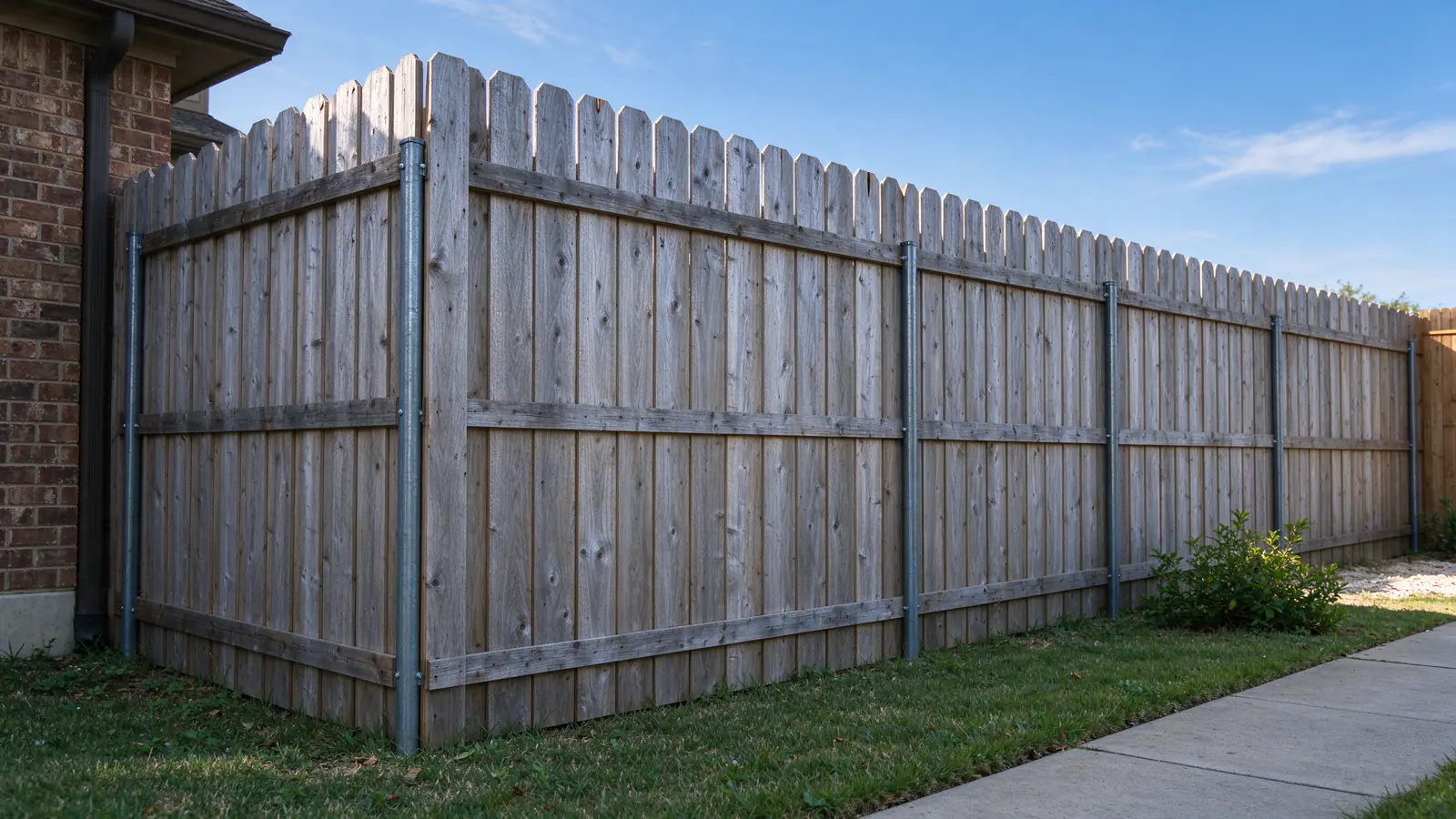
The City of Allen Residential Fence Guideline requires metal posts on all fencing, with metal caps and hardware. On a fence built that way, the post is no longer the part that quits first. Galvanized steel does not rot and termites ignore it, so the cedar boards and rails become the clock. The steel vs wood posts guide covers galvanizing and post sizes.
This is also why many older Allen fences arrive at the end of their life all at once: a run of wood posts rots through at the same depth, a storm pushes on the solid face, and a long section goes over together. Replacing that fence on steel resets the weakest part of the design.
Allen conditions that shorten a cedar fence
Termites. Allen’s adopted building code lists termite pressure as Very Heavy. Cedar’s natural oils slow insects down but do not make the wood immune, especially once those oils weather out of the surface. Mulch beds piled against pickets give termites a hidden path straight into the boards.
The bottom gap. In the 3 ft lot-line drainage easement, the City wants the bottom of the fence at least 3 in above finished grade. That gap is good for the wood as well as the drainage: pickets that never touch soil dry out after rain instead of wicking water.
Sun and wind. South and west faces take the most UV and heat, so they gray and check first. Solid privacy fences also catch the full force of storms; the adopted code uses a 105 mph design wind speed for Allen, and a fence with tired rails and loose fasteners is the one that sheds boards in a gust.
Sprinklers. A spray head hitting the same boards every morning keeps them wet half the day. Those boards go green, then soft, years ahead of the rest of the line.
How to tell a fence is near the end
Look at the posts first. Push on the fence midway between posts and at each post. A wood post that moves at the ground, or shows soft wood when probed with a screwdriver just below the surface, is near failure, and if most of them do it the whole line is. Then look at the rails: sagging rails and nails that keep backing out mean the wood has lost its grip. Graying faces on their own are cosmetic.
If posts are steel and solid, the fence can often be re-boarded rather than rebuilt. If posts are wood and failing along the line, a patch tends to buy a season. The repair or replace guide and the repair or replace assessment walk through the checks, and fence replacement covers the rebuild on steel.
Habits that add years
- Stain after the wood dries, then keep it up. The stain timing guide gives the water test; fence staining covers recoats.
- Turn sprinkler heads away from the fence line and keep mulch a few inches off the pickets.
- Replace single boards early. A cracked picket lets water into the rail behind it.
- Tighten or replace loose fasteners before wind finds them.
None of these turns cedar into a permanent material, but together they decide whether a fence is tired at year 12 or still straight at year 20. To price a replacement before the old one fails, the fence cost estimator gives typical DFW-area ranges.