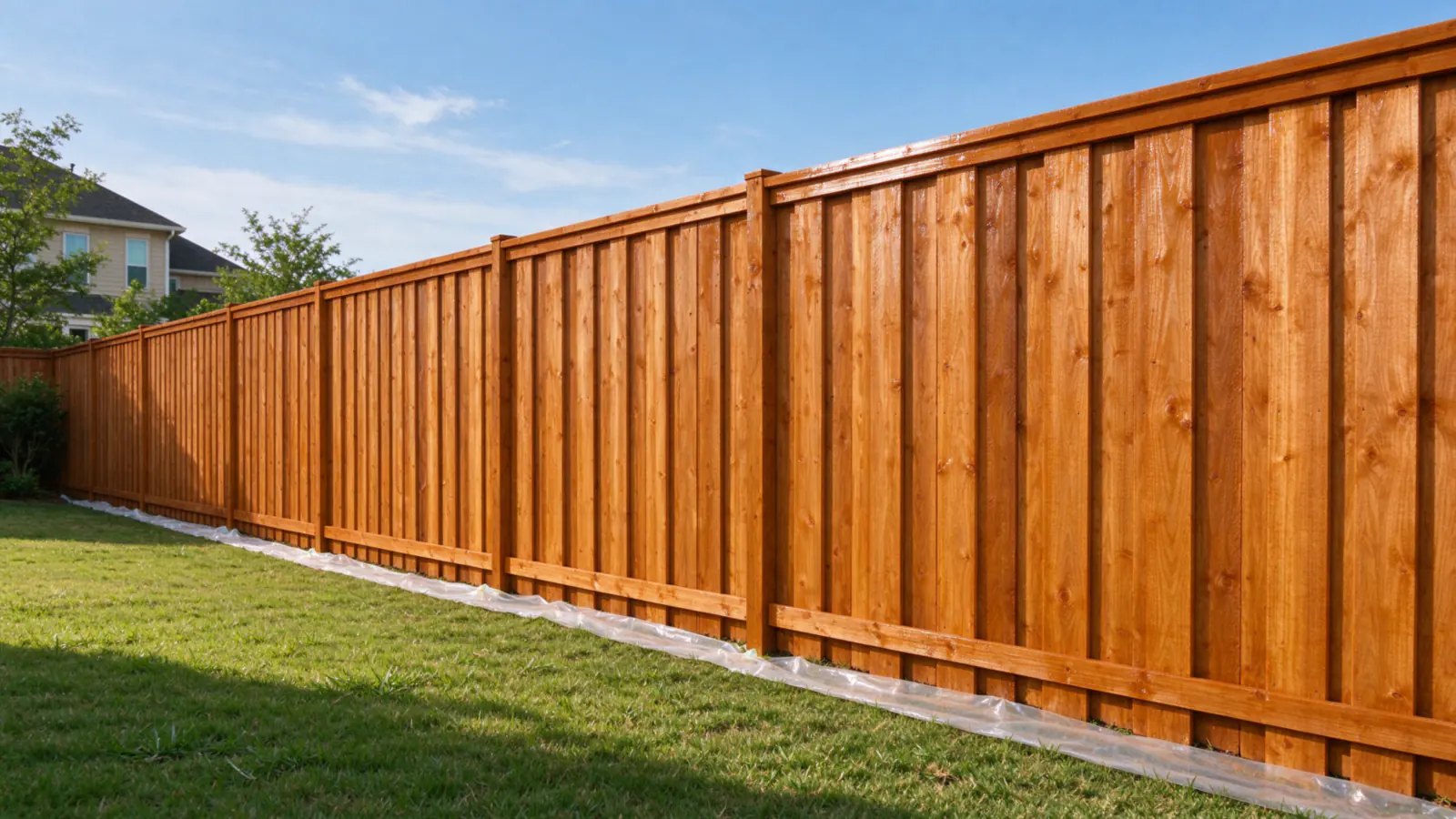
Garth Allen Fence Builders cleans and stains cedar fences in Allen and nearby Collin County cities, from a new fence ready for its first coat to a ten-year-old fence gone silver and rough. The work is carried out by insured fence contractors registered with the City of Allen. Staining is maintenance rather than construction, but it is planned with the same attention to how wood behaves here: strong sun, clay that holds water against anything near the ground, and long dry summers broken by heavy storms.
What stain actually does for cedar
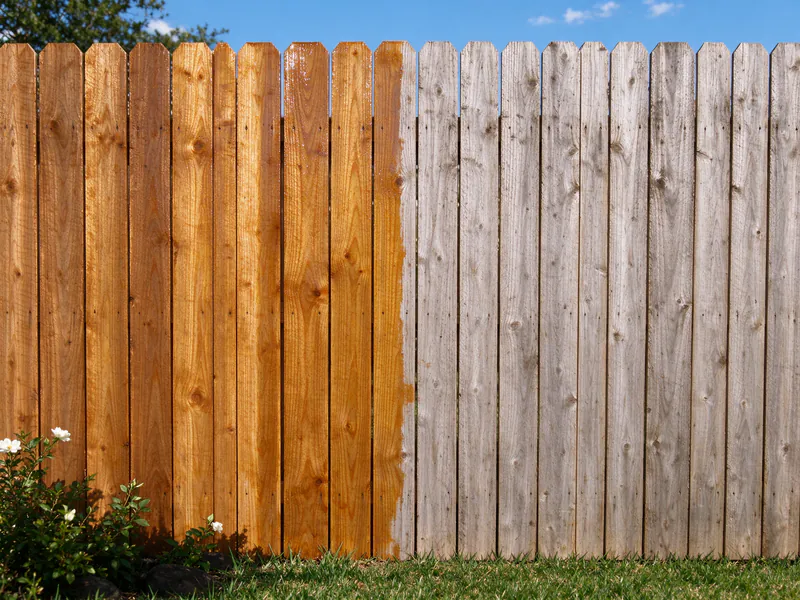
Cedar’s color fades because sunlight breaks down the lignin that binds the wood fibers at the surface. Rain washes the loosened fibers away and the board turns gray, then rough. At the same time, bare wood soaks up water after every storm and sprinkler cycle and dries out again in the heat, and that swing is what drives cupping, checking and split board ends. The warping and splitting guide explains the movement in detail.
A penetrating stain works on both problems. Pigment shades the surface from UV, and oils or resins slow how fast water gets in, so the board moves less between wet and dry. Allen’s residential code rates weathering as “Moderate,” but a south- or west-facing run in full sun takes far more punishment than the shaded side of the same fence, and it usually needs a recoat first.
What stain cannot do is fix rot. Allen’s code also rates termite pressure “Very Heavy,” and decay and termites work where wood meets damp ground. That is the reason the City requires metal posts on every fence, and why a fence that still stands on wood posts is a repair or replacement question before it is a staining question.
When a new fence is ready
New cedar often arrives damp, and stain cannot soak into wood that is already full of water. Smooth-faced boards can also carry a glaze from the mill that sheds stain. Waiting a few weeks lets the wood dry and the surface open up; in Allen’s summer heat that can happen fast, and in a cool wet spring it takes longer. A simple check is to splash a little water on a board: if it darkens the wood and disappears quickly, the board is ready. The when to stain new cedar guide goes through timing, and a new cedar fence can be planned with staining in mind from the start.
Preparing a weathered fence
An older fence needs more work before any stain goes on. The first step is a walk along the line to find loose pickets, split boards, popped fasteners and soft spots at the bottom, because staining over damage only hides it for a season. Those boards get fixed or replaced first.
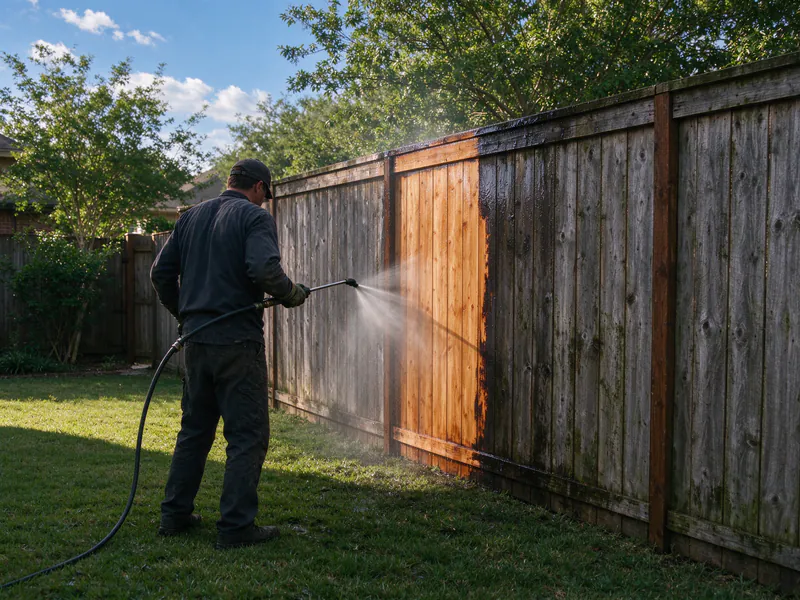
Then the wood is cleaned. A wood cleaner lifts the gray fibers and mildew, and a brightener restores the natural tone so the stain goes on even. A pressure washer helps rinse but can tear the grain if held too close, leaving a fuzzy surface that soaks stain unevenly. After cleaning, the fence needs to dry for at least a couple of days. Fences with boards of different ages, common after a storm repair, take extra prep so new and old wood end up close in color.
The bottom edge and the end grain
The bottom few inches of a fence age fastest. Picket ends soak up water through the end grain like a straw, sprinklers wet the same strip every morning, and clay splashed up by rain holds moisture against the boards. Along the lot-line drainage easement, Allen asks for the bottom of the fence to sit at least 3 inches above finished grade, which keeps the pickets out of the mud but leaves their cut ends exposed. Those ends, the tops of pickets on fences without a cap, and the faces of rails where water sits get extra stain worked in, because that is where a stained fence usually starts to fail first.
Choosing the stain and the color
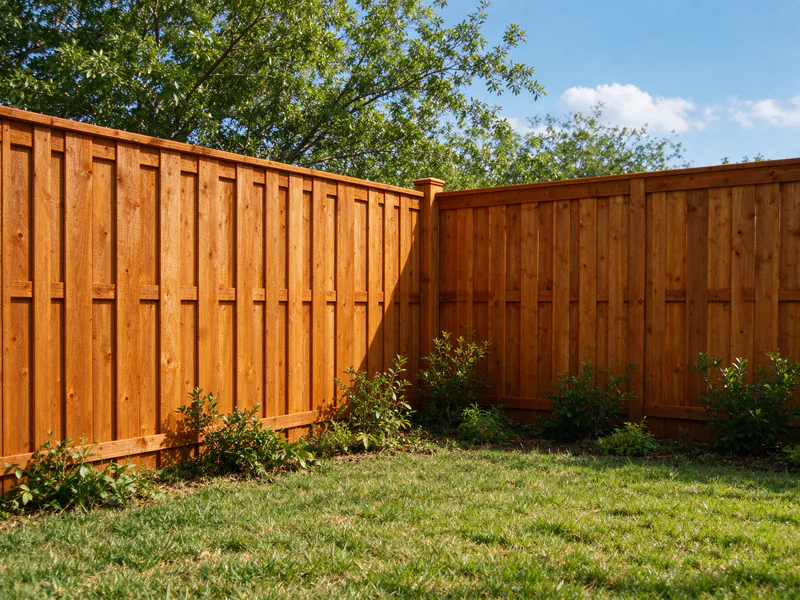
Most cedar fences around Allen get a semi-transparent penetrating stain: enough pigment to block UV and even out the color, while the grain still shows. Clear and toner finishes keep the most natural look but gray sooner. Solid stains cover like paint, hide mismatched boards and protect best, but they form a film that can peel and later needs scraping.
Color is often not only the owner’s choice. Where the HOA sets approved fence colors, the stain has to match that list, so the color gets checked before any work starts. Oil-based stains penetrate deeply and fade gradually; water-based stains dry faster and clean up easier. Either works when the wood is prepared properly.
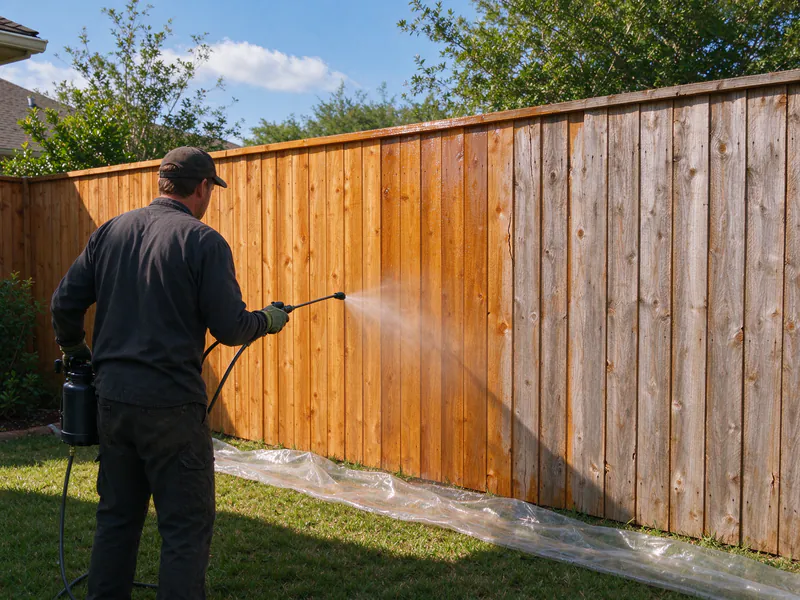
Protecting everything near the fence
Fences in Allen sit beside brick walls, driveways, cars in the alley, pools, sprinkler heads and flower beds, and stain mist travels in a breeze. Spraying is fast, but every application is back-brushed so the stain works into the grain and does not puddle on the surface. Galvanized steel posts and caps, the brick, the concrete and nearby plants are masked or covered, and work is planned for calmer parts of the day. In the peak of summer the hottest hours are avoided too, because stain that flashes dry on a hot board does not soak in. Near a pool, the deck and the water are covered, and if the fence forms part of a pool barrier, gate hardware is kept clear of stain so hinges and latches still close properly.
Your side, the neighbor’s side
Every fence has two faces, and on a shared line the far face is reached from the neighbor’s yard. Staining that side needs their agreement, and many owners use the chance to split the cost and finish both faces in matching color. Board-on-board cedar looks the same from both sides, so a one-sided stain shows more on it than on side-by-side. The property line guide covers shared fences more broadly.
How often, and what it costs
Typical DFW-area budgeting runs about $3.50 to $7 a foot to stain one side. Board-on-board has roughly a third more surface than side-by-side, heavily weathered wood drinks more product, and solid stains, extensive repairs or tight access push a job toward the top of the range. Recoating is set by exposure rather than the calendar: sunny runs fade first, and when water stops beading and the color has dulled, the fence is due. The cedar lifespan guide shows how regular staining fits into a fence’s life, and the after-summer care post lists what to look at each fall. If the fence is too far gone to be worth staining, the repair or replace assessment helps make that call.