Garth Allen Fence Builders plans and installs automatic driveway gates in Allen and the nearby Collin County cities: sliding gates across alley drives, swing gates at the end of a front drive, and openers added to a sturdy existing gate. An automated gate is a fence gate, a machine and a safety system at once, and each part has its own failure points. The work is carried out by insured fence contractors registered with the City of Allen, and every project starts with the same question: will this gate move freely and stay square for years before a motor ever touches it? Manual walk and drive gates are covered on the gate installation page.
Start with a gate that moves well by hand
An opener only moves what it is attached to. If the gate binds, drags on the slab or leans on its latch, the operator works against that resistance on every cycle, and the motor, the arm brackets and the hinges wear out early. Before anything is automated, the gate should open and close with one hand, hold its shape, and land on its stop without being lifted.
That is why most automated wood gates in Allen are built on a welded steel frame, with cedar pickets fastened to the face. A wood-framed drive gate racks under its own weight over time; a steel frame does not, and it gives the operator a solid point to bolt to. Iron and ornamental steel gates are already rigid and suit automation well, which is one reason iron fencing and automated drive gates are often planned together. If an existing gate already sags, the sagging gate guide explains what is usually behind it.
Swing or slide on an Allen lot
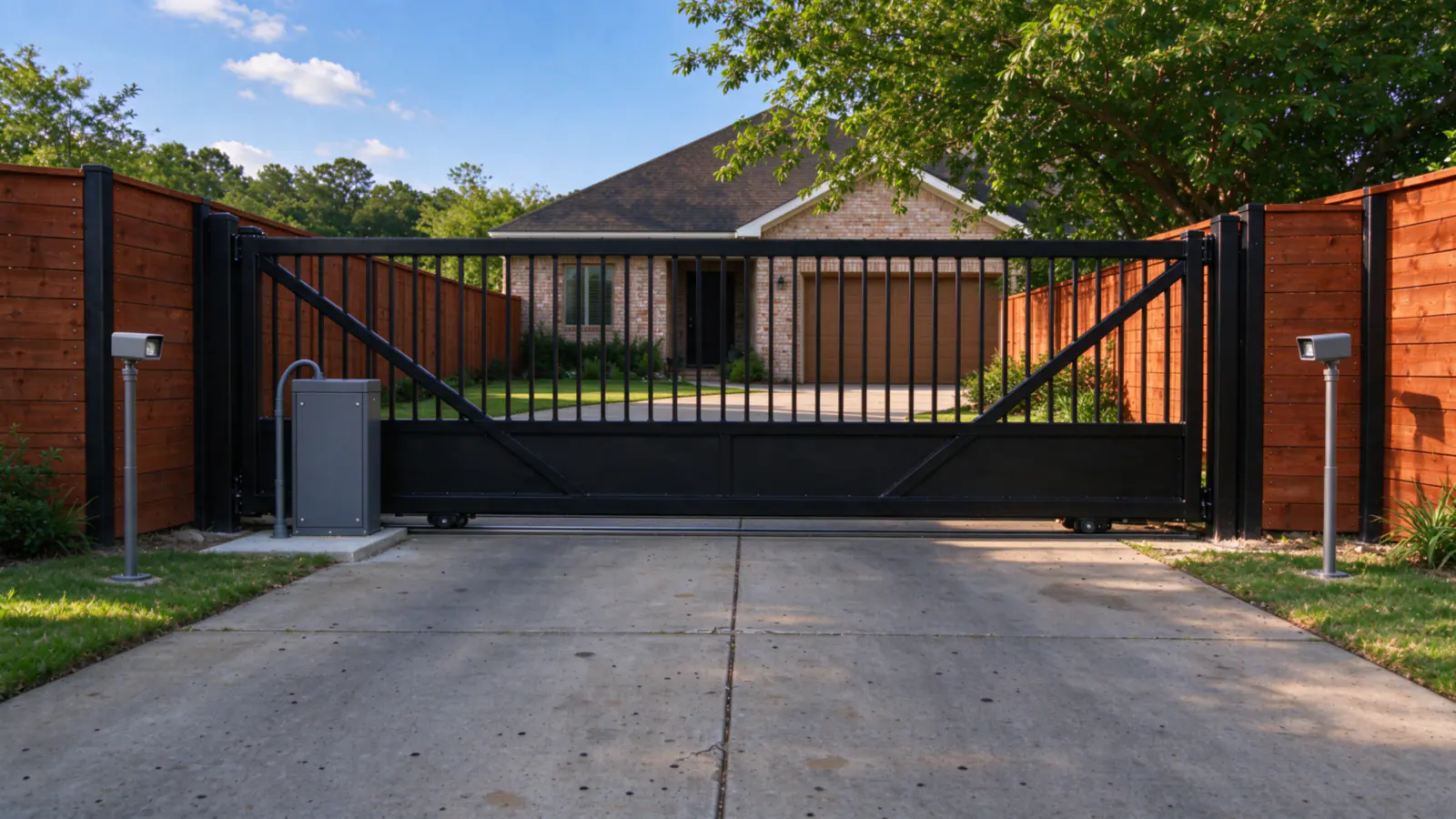
Many Allen subdivisions are alley-loaded, with the garage at the back and the drive opening onto the alley. Those drives are short, and a swing gate needs a clear arc inside the yard for each leaf. Cars parked close to the gate, a slab that rises toward the garage, or trash bins stored by the drive can all sit in that arc. A slide gate avoids the arc but needs a straight stretch of fence beside the opening where it can park when open, usually a little longer than the opening itself.
Swing gates on alley drives open inward. Allen requires fences to stay on private property without crossing the property line at any point, and a leaf swinging over the alley would do exactly that. Front drives with a long, level approach suit swing gates well and give a classic look in iron. The swing vs sliding gate guide walks through the choice in more depth.
Sliding gates and Allen’s trash-bin layouts
Allen adds a rule specific to automated gates on alleys. A sliding gate across a rear-entry driveway must follow one of two trash-bin pickup layouts drawn in the City’s engineering standard details for electric gates, and the chosen option has to be named on the fence permit application. The reason is practical: collection trucks pick up from the alley, and a closed gate cannot stand between the bins and the truck. The two layouts place bin pads outside the gate line so pickup carries on whether the gate is open or shut.
Choosing the layout early affects where the gate track starts, where the operator sits, and whether a short section of fence has to move to make room for the pad. It is also a permit item, so it gets settled before the gate is fabricated. The Allen permit rules guide covers the rest of the application.
Posts, clay and wind
A drive gate puts a heavy, moving load on one or two posts, and those posts sit in Houston Black clay, the very high shrink-swell soil mapped across most of Collin County. As the clay swells in a wet spring and shrinks in a dry summer, a footing can shift a fraction of an inch. On a manual gate that shows up as a latch that no longer lines up. On an automated gate the same movement throws off the limit settings and the photo-eye alignment, and the operator may stop and reverse for no visible reason.
Gate posts are steel, as Allen requires for all fencing, and they go well past the City’s 18-inch minimum depth in straight-sided holes, with concrete crowned to shed water. Slide-gate guide posts and the track base get the same care, because a track that tilts as the clay moves will drag the gate. The clay soil guide explains why hole shape matters as much as depth.
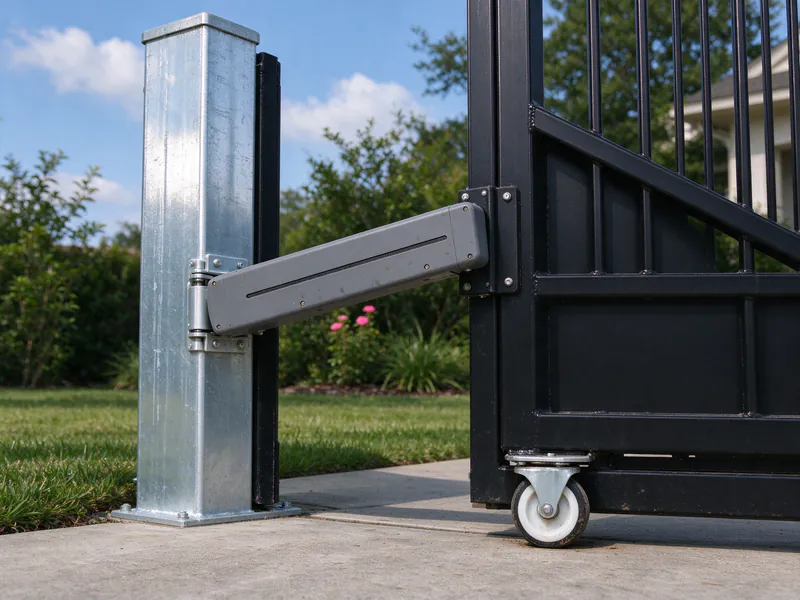
Wind is the other load. Allen’s residential code uses a 105 mph design wind, and a solid cedar drive gate is a large flat panel. On a swing gate, a gust pushes the leaf against the operator arm and gearbox; on a slide gate, the force spreads across the rollers and guide posts. Solid-faced gates get heavier frames and an operator sized for the leaf, and some owners choose a shadow box or iron design that lets air through.
Entrapment protection and the standards behind it
Two standards shape a safe automated gate. UL 325 governs gate operators and calls for monitored entrapment protection: the operator checks that its photo eyes and edge sensors are connected and working, and will not run normally if they are not. ASTM F2200 covers how the gate itself is built, including guards over slide-gate rollers and limits on openings near moving parts where a hand could be caught.
In practice that means photo eyes across the opening on both sides, edge sensors on leading edges where a gate closes against a post, and a careful look at the zone where a slide gate passes its guide posts. The automatic gate safety guide goes through each zone and the checks worth repeating every few months.
Power, controls and outages
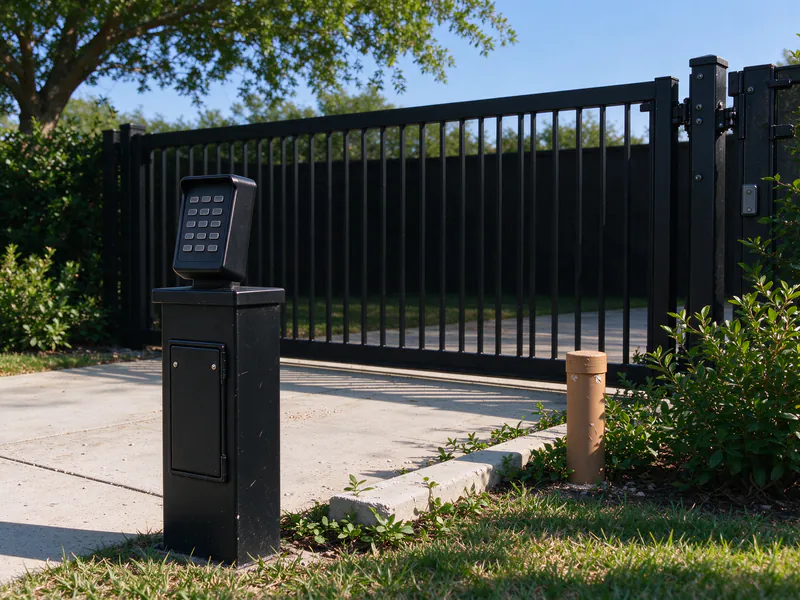
An operator needs a power source: a circuit run from the house, or a solar panel charging a battery. Solar avoids a trench across the yard but depends on panel placement and battery size, and shade from a neighbor’s tree or a two-story wall can leave it short in winter. Access controls are chosen next: remotes, a keypad on a post set back from the drive, and often a vehicle exit sensor so a car leaving does not have to stop. Every operator has a manual release, and a battery backup keeps a mains-powered gate running through short outages.
Cost and permits
Typical DFW-area budgeting for an automated gate runs about $1,500 to $4,000 each with the opener. Width and weight, slide or swing, a steel or cedar-faced frame, the number of sensors, the access controls and the length of the power run decide where a project lands. A manual double drive gate typically runs $400 to $900 on its own, so automation is a meaningful step up. The gate goes on the fence permit with the rest of the fence, and HOA approval comes first where one applies. The fence cost estimator and the Allen fence cost guide help put the gate in the context of the whole fence, and a cedar fence or replacement is the natural time to add one.