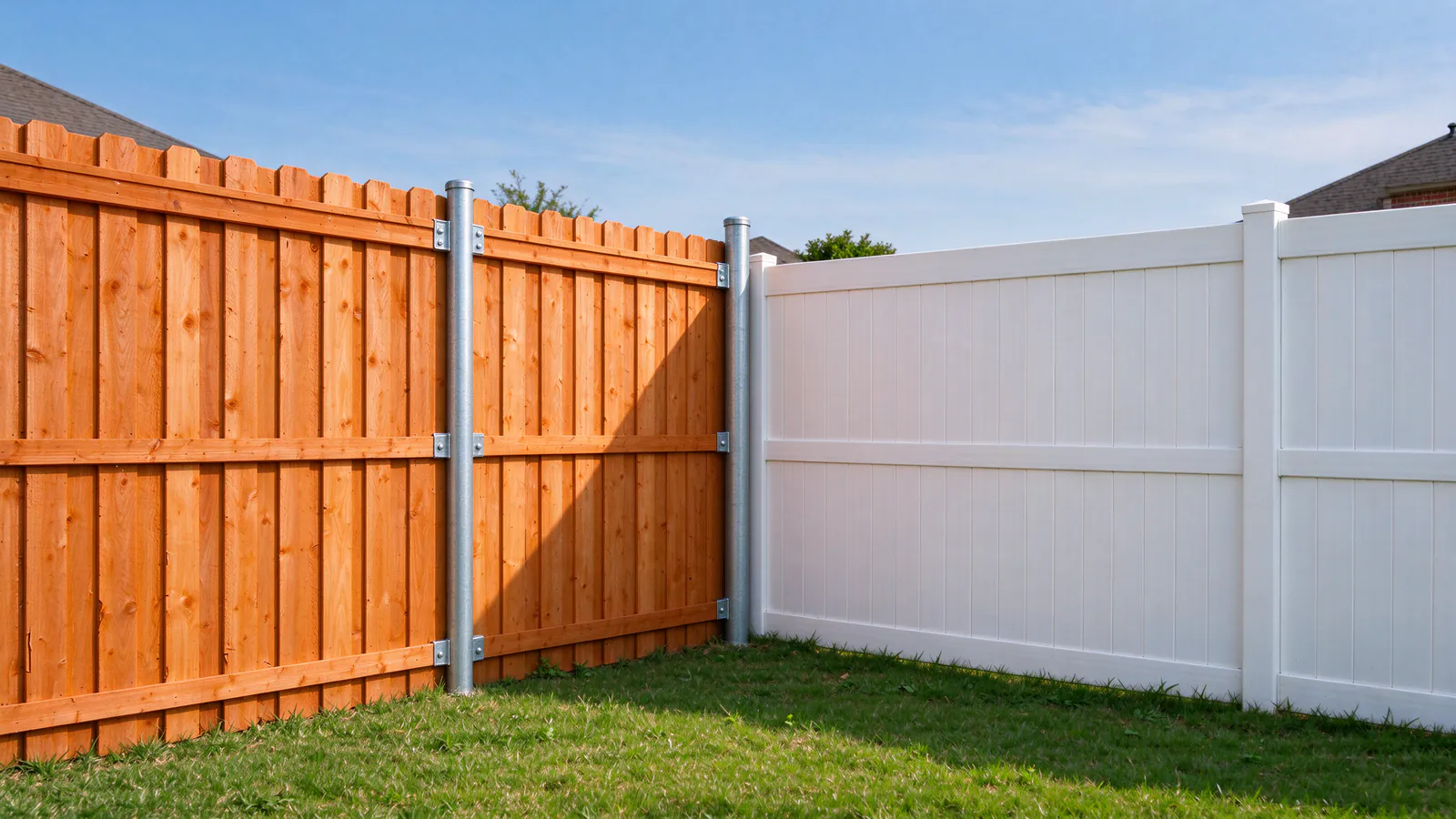
Garth Allen Fence Builders put this comparison together for Allen owners weighing a cedar privacy fence against vinyl.
In Allen, cedar on steel posts is usually the simpler choice: wood is on the City’s accepted material list, costs less per foot in side-by-side style, and can be repaired board by board. Vinyl needs less upkeep but requires the Building Official’s approval, must meet the metal-post rule, and typically costs more.
In most cities this is a straight trade between upkeep and price. In Allen, the City’s material rules come first.
The Allen rule that shapes the decision
The City of Allen Residential Fence Guideline names brick, wood and wrought iron as acceptable materials. Everything else, vinyl included, needs the Building Official’s approval. The same guideline requires metal posts on all fencing, with metal caps and hardware.
That matters for vinyl because most residential vinyl privacy systems use hollow vinyl posts, sometimes with a steel or aluminum insert. Whether a given system satisfies the metal-post rule is a question for the Building Official, before you order panels. Your HOA may have its own view; the City asks owners to check with the HOA before applying for the permit. The Allen permit rules guide lays out the sequence.
In practice, an approval step adds time and uncertainty at the front of the project. The Building Official has to accept the material and its post system before the fence can move forward, and if the answer is no, the design changes. With cedar on steel, that conversation never happens.
Side by side
| Factor | Cedar on steel posts | Vinyl |
|---|---|---|
| Allen approval | Accepted material | Needs Building Official approval |
| Typical DFW-area cost | $18–$35 / ft side-by-side; $35–$50 / ft board-on-board | $25–$45 / ft standard privacy |
| Upkeep | Stain every few years; replace boards as needed | Wash; no stain |
| Termites and rot | Cedar resists but is not immune; keep it off the soil | Not affected |
| Heat | Dries, grays, can cup | Expands; needs room to move |
| Impact | Dents and splits; one board replaced | Can crack; panel or section replaced |
| Wind | Steel posts carry the load | Depends on post and insert system |
| Repairs years later | Cedar is always available | Matching color and profile can be hard |
Upkeep, honestly
Cedar’s upkeep is real. Allen sun grays it within a season or two, and a fence left unstained cups and checks faster. The stain timing guide covers the first coat, and typical DFW-area staining runs $3.50 to $7 a foot for one side.
Vinyl is not maintenance-free either. It collects dust and mildew on shaded sides and needs washing. It does not need stain or sealer, which is its main advantage. Allen’s adopted code rates termite pressure as Very Heavy, and vinyl sidesteps that entirely, while cedar depends on staying off the ground; the 3 in bottom gap the City wants in the drainage easement helps there.
Heat, wind and clay
Heat. Vinyl moves more with temperature than wood. Systems are designed with slotted rail pockets so rails can slide; a fence cut too tight can bow in July. Dark vinyl colors absorb more heat and move more.
Wind. Allen’s adopted code uses a 105 mph design wind speed. A solid privacy fence in either material catches the full load, so the post system matters more than the panel. Cedar on galvanized steel posts at least 18 in in concrete is a known quantity; a vinyl system’s wind performance depends on how its posts are reinforced.
Clay. Houston Black clay heaves and shrinks with the seasons. A cedar fence can be adjusted board by board as posts settle; vinyl panels locked into routed posts tolerate less movement before rails pop out or bind. The clay soil guide explains the movement.
Lifespan
Neither material comes with a guaranteed lifespan, and vinyl does not last forever. Cedar on steel posts tends to wear out at the boards and rails, which can be replaced; the cedar lifespan guide covers what fails first. Vinyl tends to last until something breaks it or sun chalks the surface, and a cracked panel years later may not match the rest of the run.
Which one to choose
Choose cedar if you want the simplest Allen permit, the lowest price for privacy, and easy repairs. Board-on-board gives full privacy that stays closed as wood dries; the board-on-board vs side-by-side guide compares styles, and wood fence installation covers the build.
Consider vinyl if you will not stain a fence, your HOA permits it, and you are willing to go through Building Official approval first. Check the post system before anything else. For overall budgets, the fence cost guide and the cost estimator give typical ranges.