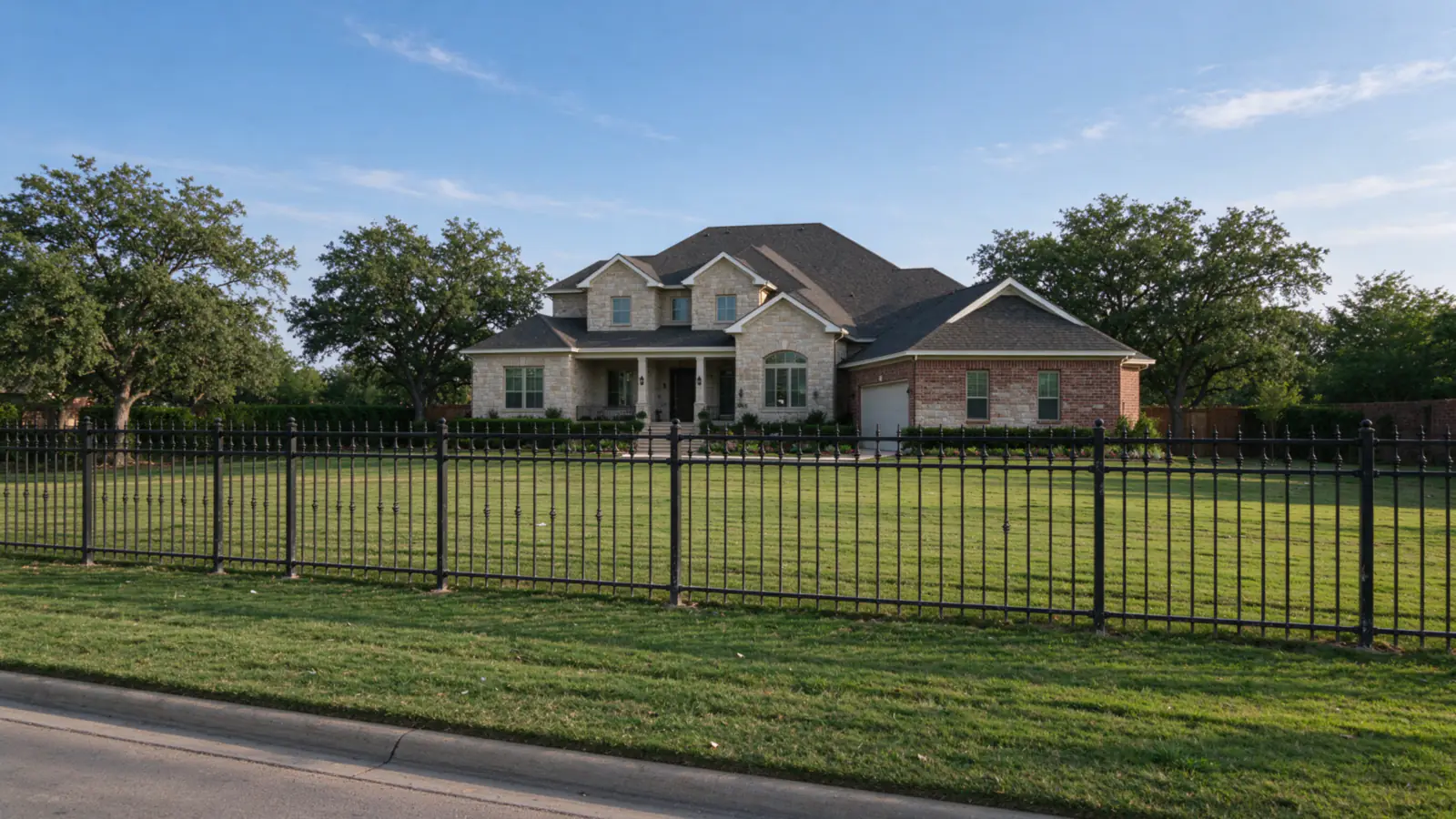
Garth Allen Fence Builders builds cedar fences, iron fences and drive gates in Fairview, the town of larger lots between Allen and Lucas along SH 5 and Stacy Road, with the work carried out by insured fence contractors registered with the city. Fairview runs its own permit process through the Town, and three parts of it shape a project from the start: a plat with every application, an easement waiver that puts the cost of easement conflicts on the owner, and a registration requirement for the fence contractor.
How a Fairview fence permit comes together
The Town’s residential fence packet lists two fees: a $25 plan review fee and a $25 permit fee. The application needs a plat of the property, which shows the lot lines and the recorded easements, so the plat is the starting point for laying out the fence rather than paperwork added at the end. On larger lots, where the fence line may be hundreds of feet long and the old fence may not follow the true boundary, the plat is often what settles where the new line can go. The property line guide explains why an existing fence is not proof of the boundary.
The form also carries a Knox box question. A Knox box is the locked key box emergency crews use to get through a locked gate, so a design with a gate across the drive should be discussed with that question in mind when the application is prepared.
The easement waiver, and why it matters
Fairview’s packet includes an easement waiver: the Town may remove items placed in a municipal easement, and the owner pays for it. In practice that means a fence built across a utility or drainage easement can be taken down when the Town or a utility needs to work there, and putting it back is the owner’s expense.
That makes the plat review more than a formality. If an easement runs along the back or side of the lot, the choice is between keeping the fence out of it, accepting the risk with a design that is easy to take apart and rebuild, or placing gates where crews would need access. Each choice changes the fence line, and it is far cheaper to decide on paper than after the posts are set.
Contractor registration in Fairview
Fence contractors working in Fairview register with the Town. A new registration costs $50 and a renewal $25, and the application includes a driver’s license and a certificate of liability insurance naming the Town of Fairview as insured. For an owner, the useful step is simply to confirm that whoever is building the fence is registered before the permit is filed, since an unregistered contractor can hold up the application.
Inspection by photo or video
The Town’s packet offers a photo or video inspection certification option for finished fences. Instead of waiting on a site visit, the completed work can be documented and submitted. Good documentation shows the full run, the posts and footings where visible, the gates and their hardware, and the fence’s position against the lot lines, so it is planned for during the build rather than pieced together afterwards.
Heights, openness and materials: confirmed per address
Fence height, how open a fence must be and which materials are allowed are set by Fairview’s zoning ordinance, not by the permit packet. Those details are confirmed with the Town for each address before a design is final, and any HOA rules are checked at the same time. Until then, a fence plan in Fairview is a draft, and the material and height are treated as open questions. It is also why a design that would pass in Allen or Murphy is not assumed to work here: each of these towns writes its own fence rules, and a house a short drive away can face a different set of limits.
Larger lots, longer lines
Fairview’s bigger lots change the shape of a fence project. Runs are longer, corners are farther apart, and drives are wider, so the gate is often the centerpiece. A wide opening may call for a double swing gate or a slide gate, and on a long drive an opener means not stepping out in the rain twice each trip. The swing vs sliding gate guide and automatic gate installation cover those choices. Open lots also leave a fence more exposed to wind than a fence sheltered between close-set houses, which favors iron and other open designs, or heavier posts under a solid one. Iron fence installation and cedar fences are the most common starting points.
Building in Fairview’s clay
Federal soil survey point data for Fairview returns Houston Black clay, the same very high shrink-swell soil found across Allen and Murphy, with a linear extensibility up to 12 percent. It swells in wet months and shrinks and cracks in dry ones, and a fence post caught in that cycle is slowly worked loose or pushed out of line. Galvanized steel posts avoid the rot that wood suffers in damp clay, and straight-sided holes with crowned concrete give the clay less to grip. Just across the line in Lucas, the same survey returns Heiden clay, which is also very high shrink-swell. The clay soil guide and the steel vs wood posts guide go deeper.
What a Fairview fence usually costs
Typical DFW-area budgeting ranges apply: about $35 to $50 a foot installed for 6 ft cedar board-on-board on steel posts, $18 to $35 for side-by-side, and $28 to $55 for iron or ornamental steel. Removing an old fence typically adds $3 to $8 a foot, a manual double drive gate runs about $400 to $900, and an automated gate about $1,500 to $4,000 with the opener. On a Fairview lot, the length of the run usually decides the total more than the price per foot, and the Town’s fees add $50. Fence replacement and fence repair cover older lines, and nearby Murphy has its own set of rules.