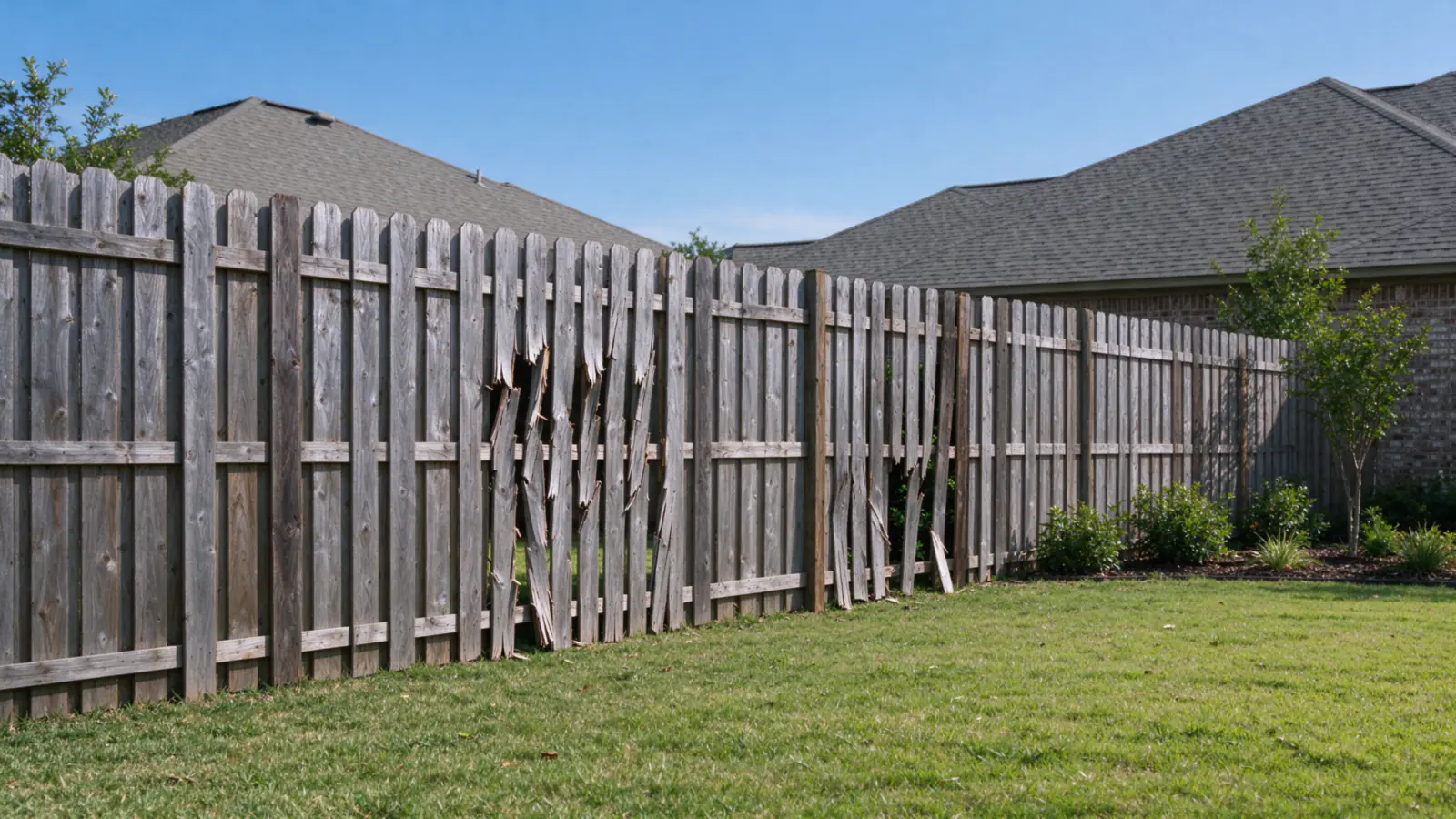
Garth Allen Fence Builders built this guide around one idea: a fence is a system of posts, rails and boards, and the condition of the posts decides most repair-or-replace calls. Boards are cheap to swap; footings are not.
Repair a fence when the posts are sound and the damage is local: a few broken pickets, a loose rail, one or two leaning posts. Replace it when posts are failing along the line, especially old wood posts soft at the ground, or when the boards are weathered through. In Allen, any new post must be steel.
Check the posts first
Walk the line with a level and push on each post at chest height. A good post feels rigid and reads plumb. Then look at the base. Wood posts fail at the soil line, where turf moisture and Allen’s Very Heavy termite pressure combine; probe there with a screwdriver, and soft or crumbling wood means that post is near the end. Steel posts can rust at grade where soil or mulch has been heaped against them, or where the concrete was never crowned to shed water.
Count what you find. A handful of weak posts clustered in one area points to a local cause: a low spot that stays wet, a sprinkler head aimed at the fence, a gate loading its hinge post. Weak posts spread evenly along the line point to age or to footings that were too short for Houston Black clay. The clay soil guide explains what that soil does to a footing.
Then the rails and boards
Rails split, sag between posts, or pull loose at the brackets. Pickets cup, crack, go gray and soft at the bottom, or drop off as nails rust. Look at the bottoms, where boards sit closest to wet ground. Cedar that is gray but firm can still be cleaned and stained; cedar that is spongy or splitting at the end grain is past saving. The cedar lifespan guide covers what wears out first.
Repair-or-replace decision table
| What you find | Usually means | Likely scope |
|---|---|---|
| A few broken pickets, posts solid | Local damage | Repair: replace pickets |
| One or two leaning posts in one area | Local footing issue | Repair: reset posts in new footings |
| Storm damage to one or two sections | Impact or wind on a sound line | Repair, unless posts snapped along the run |
| Sagging gate on a sound fence | Hinge, frame or gate post | Repair the gate or its post |
| Steel posts sound, boards worn out | Boards past their life | Re-board on existing posts |
| Wood posts soft at grade along the line | System at end of life | Replace |
| Posts leaning along most of the line | Footings failing system-wide | Replace |
| Fence in the wrong place or on the wrong line | Location problem | Replace in the right place |
Two causes often stack, and a visible lean does not prove which one is at work. A storm can knock over a section whose wood posts were already rotted; the wind was the trigger, the posts were the reason. The storm damage guide separates the two.
How the numbers compare
Repairs are priced per job, so the comparison is between a repair estimate and the cost of a new line. For new cedar on steel posts, typical DFW-area pricing runs about $35 to $50 a foot for 6 ft board-on-board and $18 to $35 for side-by-side, plus $3 to $8 a foot to tear out and haul away the old fence. Multiply your fence length by those figures to get a replacement budget. When a repair quote approaches a large share of that number, it is rarely the better buy, especially if the parts left untouched are the same age as the parts that failed.
Re-boarding on sound steel posts sits between the two: it skips the digging and concrete, and the new fence starts its life on posts that are already settled. The Allen fence cost guide has the full price breakdown, and the repair or replace assessment tool walks through the checks above.
Rules that affect the choice
Allen’s fence guideline requires metal posts on all fencing, so any post that gets replaced goes in as steel, at least 18 in deep in concrete. A replacement fence needs a City permit, the same $75 as a new fence. For smaller repairs, confirm with the City before work starts. For comparison, neighboring Murphy writes its threshold into code: a repair permit when 15 linear feet or more, or five or more posts, are replaced. The Allen permit rules guide lists the rest.
A replacement is also the time to fix the location. Allen requires fences to sit on private property, not over the line, and an old fence is not proof of where the line runs. See the property line guide.
Next steps
Local fixes are handled through fence repair; full rebuilds through fence replacement. Both are carried out by insured fence contractors registered with the City of Allen.