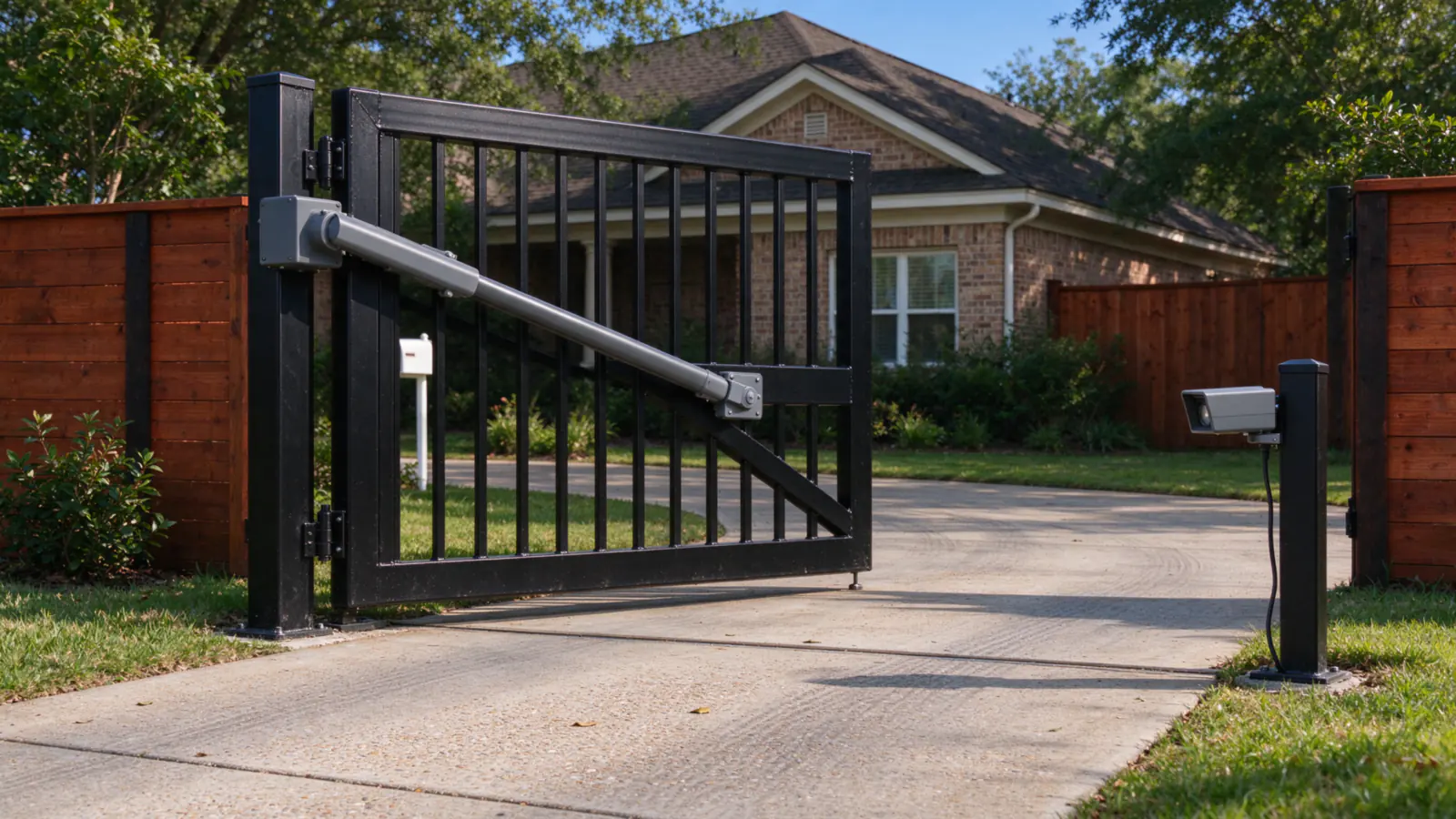
Garth Allen Fence Builders wrote this guide for Allen owners who have, or are planning, a powered driveway gate and want to know what keeps it from hurting someone.
An automatic gate is safe when it cannot close on a person, pet or car: it must sense an obstruction and stop or reverse, and its rollers, hinges and gaps must not trap hands. The UL 325 and ASTM F2200 standards set those requirements, and monthly tests confirm they still work.
A drive gate can weigh several hundred pounds, and an opener moves it with steady force. Most of the safety work is built in at installation; the rest is noticing when it stops working.
Where automatic gates hurt people
The U.S. Consumer Product Safety Commission has long warned that powered gates can seriously injure children who ride on them or get caught as they move. The danger zones are predictable:
| Zone | Gate type | What happens |
|---|---|---|
| Leading edge closing against the post | Both | A person or pet is pinned in the closing gap |
| Between the gate and the fence it slides along | Sliding | Hands or bodies are drawn in as the gate passes |
| Rollers and the receiving post | Sliding | Fingers caught at exposed wheels or guides |
| Hinge side of the leaf | Swing | The gap at the hinge closes like a door jamb |
| The arc of the leaf | Swing | A leaf swings into someone standing in its path |
| Climbing openings in the gate | Both | A child riding the gate is carried into a pinch point |
The standards, in plain terms
UL 325 is the safety standard for gate operators. It requires the opener to have entrapment protection and sorts gates into usage classes, with residential gates in their own class. In practice that means an internal sensor that detects resistance, plus external monitored devices: photo eyes across the opening and contact or non-contact sensing edges on the moving gate.
ASTM F2200 covers the gate itself. It limits openings in the gate that a child could reach through or climb, calls for guarding of exposed rollers on sliding gates, and addresses gaps where the gate passes fixed objects.
Naming the standards is the easy part. The installer’s job is to place the sensors where the real pinch points are on your drive.
How the protection works together
- Internal sensor. The operator watches motor effort. If the gate hits something and effort spikes, it stops and reverses. It reacts only after contact, so it is the last line, not the first.
- Photo eyes. An infrared beam across the opening stops or reverses the gate if broken, before contact. On a sliding gate, a second pair often covers the runback area.
- Sensing edges. Rubber edges on the leading and trailing edges of the gate react to a light touch.
- Guards and spacing. Screens over rollers, covers over gaps, and small openings in the gate’s lower section keep hands from reaching moving parts.
A gate that sags or drifts defeats these devices: photo eyes go out of alignment and edges stop meeting where they should. On Houston Black clay a gate post can move over a few seasons, so a gate that worked on day one can drift. The sagging gate guide explains why.
Allen layout details that affect safety
On an alley-loaded lot the gate opens straight onto a shared lane. A sliding gate across an Allen alley drive must follow one of the City’s two trash-bin layouts, and keeping bins out of the gate’s travel path also keeps them out of its sensors. Where the alley meets a street, the City’s 20 ft clear-vision rule keeps the corner open so drivers see the gate. The swing vs sliding gates guide covers that layout, and the permit rules guide lists the rest.
Wind matters for swing leaves: Allen’s adopted code uses a 105 mph design wind speed, and a solid leaf caught by a gust can trip sensors or strain the operator.
A monthly safety check
- With the area clear, run the gate and watch for jerky movement or noise.
- Break the photo eye beam with an object as the gate closes; it should stop or reverse.
- Press a cardboard box against each sensing edge while the gate moves.
- Look for exposed rollers, loose guards and new gaps where the gate passes the post.
- Confirm the manual release works, so the gate can be opened in a power outage.
- Keep remotes out of children’s reach and teach them the gate is not a ride.
If any step fails, switch the gate to manual until it is repaired. For new or upgraded openers, see automatic gate installation; for the frame, hinges and posts, see gate installation. Typical DFW-area costs for an automatic gate with opener are in the fence cost guide.