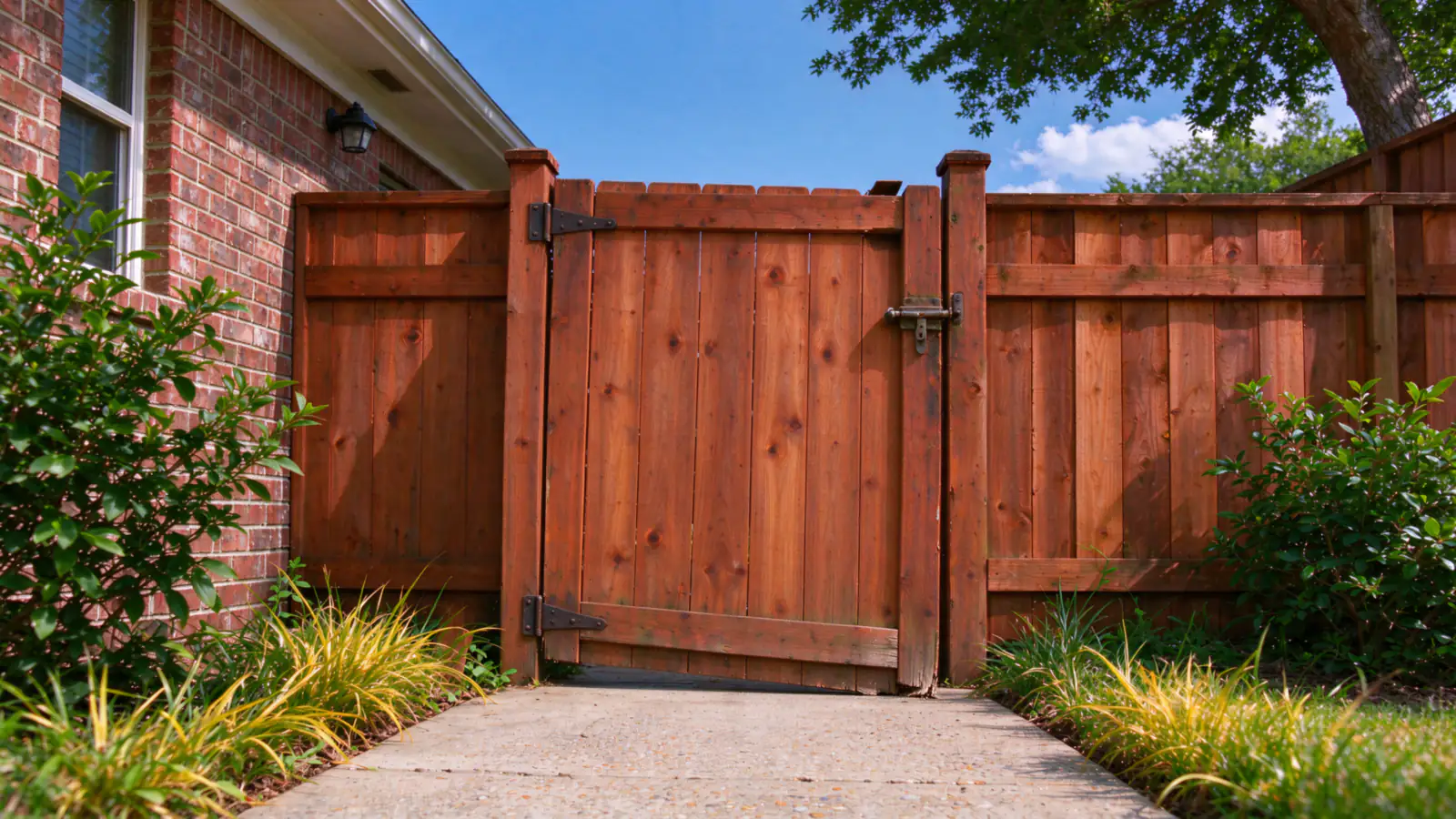
Garth Allen Fence Builders wrote this guide for the moment a gate starts scraping the walk or the latch stops lining up. Gate sag has several causes, and tightening screws only fixes one of them.
A fence gate sags because something on the hinge side is giving way: the hinges or their fasteners, the gate frame racking out of square, or the hinge post leaning in its footing. In Allen’s shrink-swell clay, a hinge post with a short footing is a frequent cause, so check the post with a level before adjusting the gate.
How a gate actually sags
A swing gate is a cantilever. All of its weight hangs off one side, on two or three hinges, and that load tries to rotate the gate downward around the bottom hinge. Three things resist it: the hinges and their fasteners, the stiffness of the gate frame, and the post the hinges are bolted to. When any one of them gives, the latch corner drops.
The useful question is which one gave, because each has a different fix.
Cause 1: hinges and fasteners
Hinges wear at the pin, and screws or lag bolts loosen in wood rails as the wood dries and swells. A gate with a sound frame and a plumb post that has dropped slightly often comes back with new hinge hardware, through-bolts in place of screws, and a check of the latch alignment.
Sign: visible play at the hinge when you lift the latch end; post plumb; gate frame still square.
Cause 2: the frame racks out of square
Cedar gates are heavier than they look, and they get heavier after rain. A wood frame held together only by its pickets and two rails will slowly shift into a parallelogram. A diagonal brace stops that, but only when it runs the right way: from the bottom corner on the hinge side up to the top corner on the latch side, so the brace is pushed rather than pulled. Gates built with the brace reversed sag almost as if they had none.
A cable and turnbuckle tightened from the top hinge corner to the bottom latch corner can lift a light walk gate back into square. On wider gates, a welded steel frame clad in cedar pickets holds its shape far better than a wood frame and matches the rest of the fence.
Sign: gap at the latch is bigger at the top than at the bottom; the gate’s corners are no longer square.
Cause 3: the hinge post is moving
This is the one that brings sag back no matter how often the hinges are adjusted. In Allen, the City’s fence guideline requires metal posts set at least 18 in deep in concrete, and that single minimum applies to every post on the line, hinge posts included. A hinge post is loaded sideways every time the gate swings, and it sits in Houston Black clay, a soil with a very high shrink-swell rating. The clay loosens its grip in a dry summer, the gate’s weight tips the post toward the opening, and the gap never fully closes again.
Older fences add another failure: a wood hinge post rotting at the soil line, where moisture and Allen’s Very Heavy termite pressure meet. The steel vs wood posts guide explains that failure.
The fix is a new or reset hinge post with heavier steel and a deeper, straight-sided footing, and sometimes a matching latch post. The clay soil guide covers how gate footings are sized.
Sign: a level on the hinge post reads out of plumb; soil cracked or gapped around the footing.
Wide gates and double drive gates
Alley-loaded lots in Allen often have a double drive gate across the back. Each leaf may be 5 ft or more, so the cantilever load is large. These gates need heavy hinges, steel frames, a center drop rod into a sleeve in the drive to hold the leaves in line, and the deepest footings on the fence. Where the drive slopes, the gate may need extra clearance or a different hinge setup so the bottom does not drag on the uphill side.
Sometimes the better answer is a sliding gate, which carries its weight on a track or rollers instead of a hinge post. In Allen, a sliding gate across a rear alley driveway must follow one of the City’s two trash-bin pickup layouts, named on the permit. The swing vs sliding gates guide compares the two.
Typical costs
| Fix | Typical DFW-area cost |
|---|---|
| New walk gate on existing posts | $150–$600 each |
| New double drive gate | $400–$900 each |
| Automatic gate with opener | $1,500–$4,000 |
Hinge hardware or a single post reset is priced per job. If the gate is motorized, an opener working against a sagging gate strains the motor and the safety sensors; see automatic gate safety.
Repair, rebuild or replace
If only the gate is failing, fence repair or a new gate through gate installation handles it. If the posts all along the line lean the same way, the gate is a symptom, and the repair or replace guide is the better starting point. Work is done by insured fence contractors registered with the City of Allen.