Garth Allen Fence Builders wrote this guide for Allen owners choosing a fence with a dog as the main reason, or replacing one a dog has learned to beat.
For most Allen dogs the best fence is a 6 ft cedar board-on-board privacy fence on steel posts, with the rails on the outside, a dig guard along the base and self-closing gates. Big jumpers may need 8 ft, which Allen allows in back and side yards; small dogs need openings they cannot squeeze through.
The right fence depends less on the breed than on how your dog gets out. Start there.
Match the fence to the escape
| How the dog gets out | What stops it | Allen notes |
|---|---|---|
| Digs under | Dig guard on the inside, tight bottom where the gap allows | Bottom 3 in above grade in the lot-line drainage easement |
| Jumps over | 6 ft minimum, 8 ft for strong jumpers | 8 ft allowed in back and side yards |
| Climbs | Smooth face on the dog side, rails facing out | HOA may dictate the finished side |
| Squeezes through | Small openings, no gaps between boards | Side-by-side pickets open gaps as they dry |
| Chews | Solid boards, metal trim at gate bottoms | Replace damaged pickets early |
| Out the gate | Self-closing hinges, a latch the dog cannot nose open | Gate posts set deeper than line posts |
Diggers and the 3-inch gap
Here is the Allen-specific wrinkle. In the standard 3 ft lot-line drainage easement, the City of Allen guideline wants the bottom of the fence at least 3 in above finished grade so water can pass. For a small dog, 3 in is an invitation; for a digger, it is a head start.
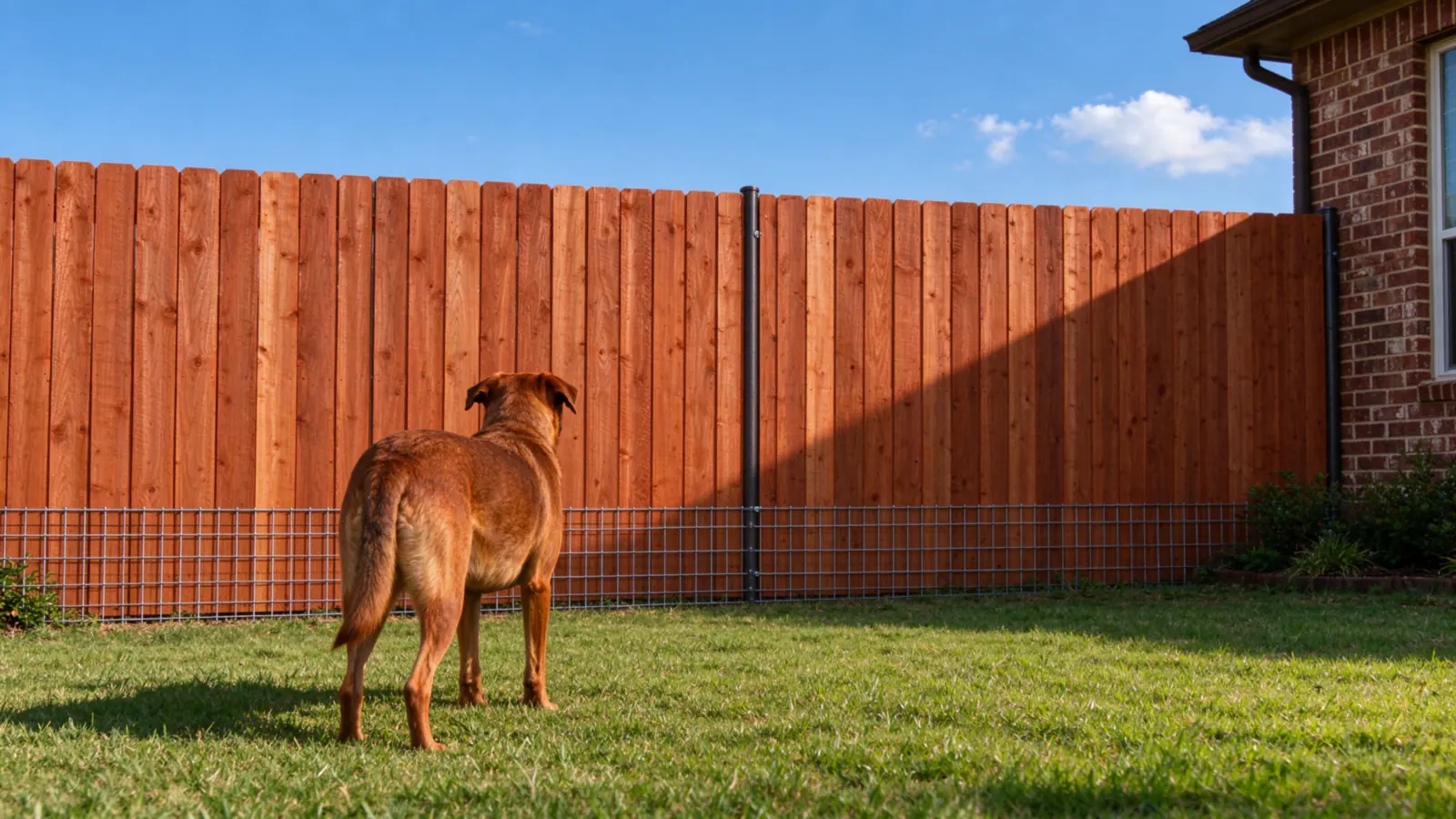
The answer is to stop the dog on your side without damming the water. A galvanized wire apron laid flat on the ground inside the fence and pinned down, then covered with soil or turf, blocks digging while water still flows over it. A row of pavers along the inside does the same. Anything that forms a solid wall at the base inside the easement defeats the purpose of the gap, so confirm the detail if you are unsure. The Allen permit rules guide covers the easement rules.
Houston Black clay helps and hurts here. It packs hard in summer, which slows diggers, then softens after rain, which is when most dig-outs happen.
Jumpers and climbers
Height is the first fix. A 6 ft fence stops most dogs; Allen allows up to 8 ft in back and side yards, measured from adjacent grade, and an 8 ft section along the run the dog patrols most can be priced separately. Expect a typical DFW-area premium of 25 to 40 percent for the taller sections.
Climbers use horizontal surfaces. On a cedar fence, put the smooth face toward the dog and the rails toward the neighbor where the HOA allows it; on board-on-board both faces are similar, which helps. Move trash bins, grills and benches away from the fence line.
Barkers, chasers and reactive dogs
A dog that sees movement reacts to it. Board-on-board cedar overlaps its pickets so no gaps open as the wood dries, which takes away the view of the alley and the neighbor’s dog. Side-by-side pickets shrink apart over time and leave slits. The board-on-board vs side-by-side guide compares the two. Typical DFW-area cost for 6 ft board-on-board on steel posts is $35 to $50 a foot installed.
Small dogs and open fences
Iron and ornamental steel look good and suit pools, but standard picket spacing can let a small dog through. Puppy pickets or mesh on the lower section close it up. Chain link is not on Allen’s residential material list and needs the Building Official’s approval, so it is not the easy default it is elsewhere. In Murphy, welded and woven wire are prohibited outright, which rules out mesh add-ons there. See iron fence installation for ornamental options.
The gate is the weak point
More dogs escape through gates than over fences. A gate that sags drags, gets propped, and stops latching. Self-closing hinges and a latch set high enough that a dog cannot nose it open fix most of that, and gate posts set deeper than the line posts keep the gate square in shifting clay. The sagging gate guide explains the cause, and gate installation covers hardware.
For the fence itself, wood fence installation covers cedar on steel posts, and the cost estimator gives a starting budget.