Garth Allen Fence Builders gets this question in two forms: homeowners comparing quotes for a new fence, and owners of an older fence wondering why the posts gave out before the boards. In Allen the answer is partly settled by rule, but the reasons behind the rule are worth knowing.
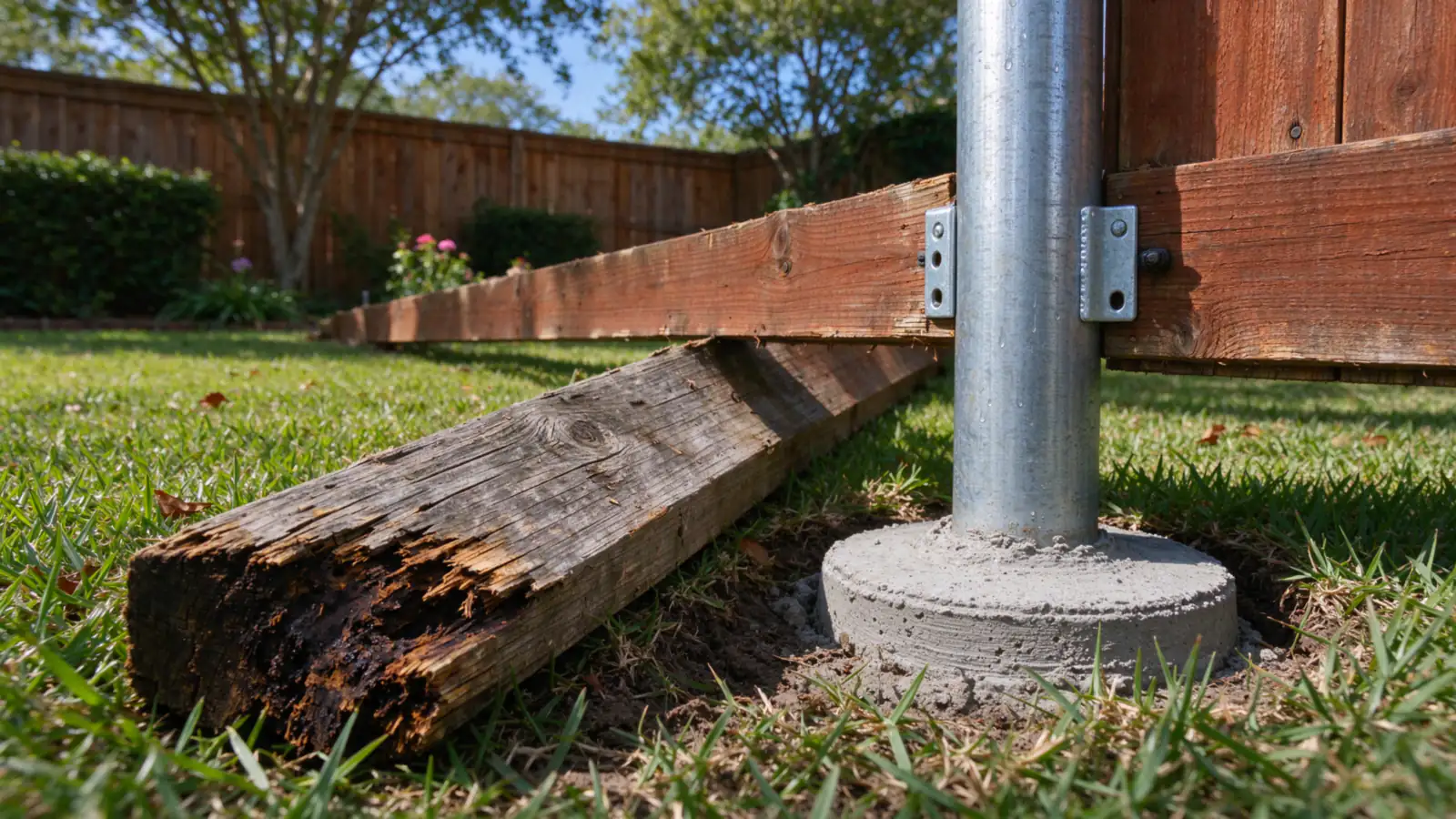
Steel posts outlast wood posts in North Texas because they do not rot or feed termites at the ground line, where wood posts fail first. The City of Allen requires metal posts on all fencing, so a new Allen fence uses galvanized steel posts in concrete with cedar rails and pickets attached above.
Where a wood post actually fails
Pull an old wood post out of an Allen yard and the pattern is usually the same: the part buried in concrete is soft, the part above the grass is sound, and the failure sits in a band a few inches either side of the soil line. That band stays wet longer than anything above it, because sprinklers and rain soak the turf and the concrete collar holds water against the wood. It also gets oxygen, which buried wood deep in the hole does not. Decay fungi need both.
Termites make it worse. Allen’s amended building code table rates termite pressure “Very Heavy,” the top category, and a wood post is a direct path from the soil into the fence. Pressure treatment slows both problems but does not stop them, and cut ends exposed during installation take the treatment less well than the factory faces.
The result is a fence whose boards still look fine while the posts snap at grade in a strong north wind. Post failure at grade is one of the main reasons an older wood-post fence ends up replaced rather than repaired, as the repair or replace guide explains.
What steel changes
A galvanized steel post has no organic material for fungi or termites to eat, so the ground-line weak point disappears. Steel also does not shrink, twist or check as it dries, which matters for the look of the fence: a wood post that twists a few degrees pulls the rails with it and opens a visible kink in the line. Steel posts tend to stay plumb unless the footing itself moves.
That last point is the honest limit. Steel does not fix a footing that is too shallow or the wrong shape for shrink-swell clay. A steel post in a short, flared collar can still heave and lean. Footing depth and shape are covered in the clay soil guide.
| Wood post | Galvanized steel post | |
|---|---|---|
| Ground-line rot | Main failure point | Not a factor |
| Termites | Can travel up the post | No food source |
| Straightness over time | Twists and checks | Stays straight |
| Allowed on new Allen fences | No | Yes, required |
| Look | Matches cedar | Bare, painted, or wrapped in cedar |
| What still matters | Treatment, drainage | Footing depth, coating, crowned concrete |
Allen’s rule, and why it reads the way it does
The City of Allen Residential Fence Guideline lists brick, wood and wrought iron as acceptable materials and then requires metal posts on all fencing, with metal caps and hardware. So wood is welcome as boards and rails but not in the ground. The caps keep water out of the open top of a tubular post, and metal hardware avoids pairing steel with fasteners that corrode first. Posts must be set at least 18 in deep in concrete. The full list of requirements is in the Allen permit rules guide.
Making steel look like a wood fence
Brackets behind the boards. Rails bolt to the posts with exterior-rated brackets, and on board-on-board the overlapping pickets hide the posts from the outside face. The inside shows a row of galvanized posts at regular spacing.
Paint. A dark exterior paint over galvanized steel makes the posts recede, especially against stained cedar.
Cedar wrap. Boxing each post in cedar boards gives a full wood look from both sides. It adds material and labor, and the wrap should stop above grade so it does not wick water.
Cap and trim. A top cap rail and trim board run across the post tops, so the steel cap is covered and the fence reads as a finished wood structure.
Gate posts are a separate decision
A gate post carries a cantilevered load every time the gate opens, and on clay that load works the footing loose over time. Gate posts get heavier steel and a deeper footing than line posts, and wide drive gates may need a frame that ties both posts together. If a gate already drags, the sagging gate guide walks through the causes, and gate installation covers new openings.
Where to go next
For a new cedar fence, wood fence installation explains the build, and the cedar lifespan guide covers how long the boards themselves last once the posts are no longer the weak point. The work is done by insured fence contractors registered with the City of Allen.