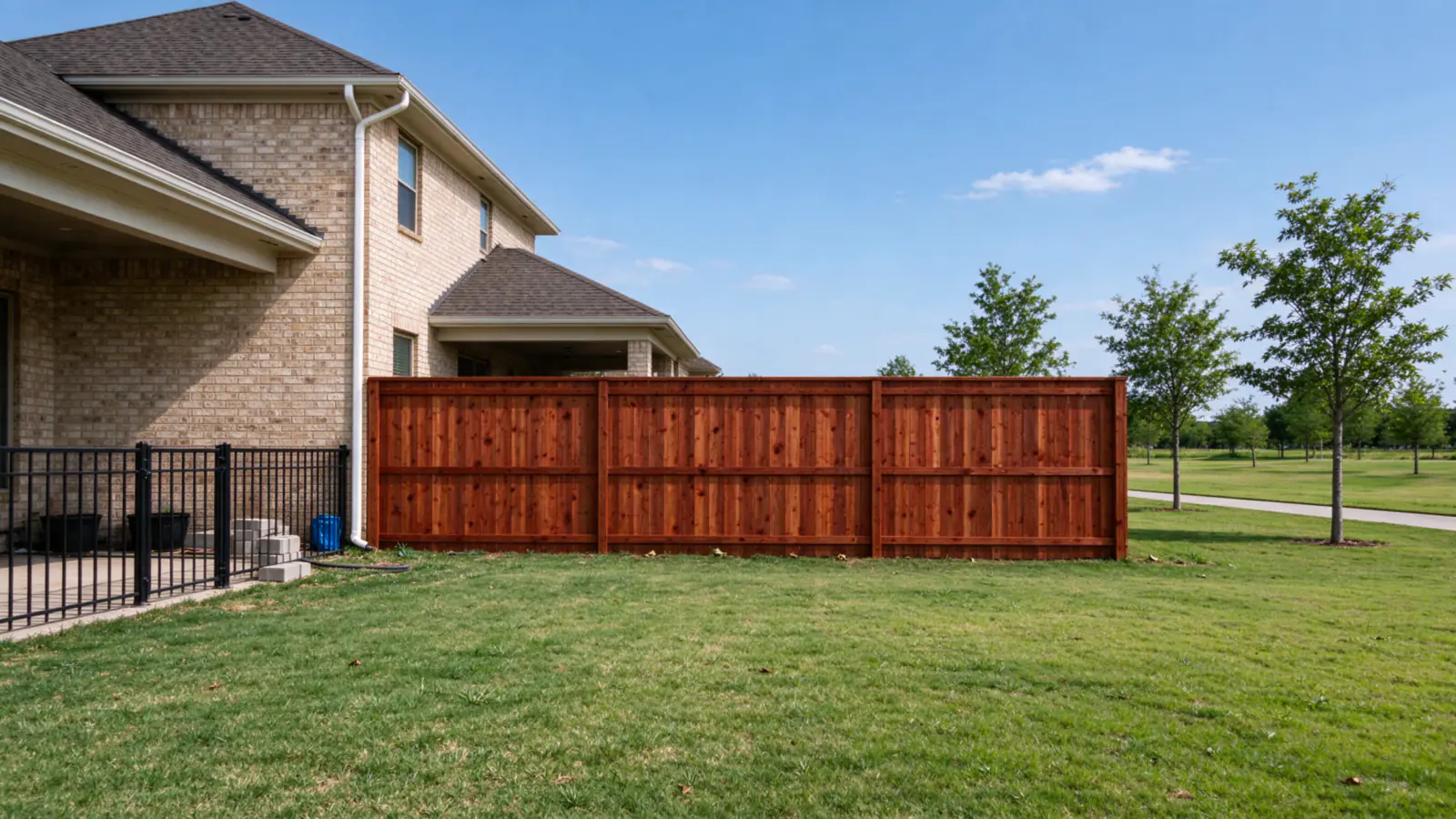
Garth Allen Fence Builders builds cedar privacy fences, iron fences and gates in Murphy, the city on FM 544 between Plano and Wylie, with the work carried out by insured fence contractors registered with the city. Murphy writes its own fence rules, and three of them change how a Murphy project is planned compared with neighboring Allen: a post-depth table tied to fence height, a repair permit that starts at 15 feet, and a short list of approved wood treatments.
Murphy’s fence rules, and what they change
Murphy’s fence code limits residential fences to 8 ft and measures height from the grade on the applicant’s side, or from the top of a retaining wall when the fence sits on one. Post depth is set by height. A 4 ft fence needs 18-inch posts, a 6 ft fence needs 2 ft, and anything 8 ft or taller needs 3 ft. That last step matters for owners raising a fence against a two-story neighbor: going from 6 ft to 8 ft adds a foot of depth to every post, on top of the longer posts and extra pickets. The clay soil guide explains why deeper footings also help in this ground.
Repairs have their own threshold. Replacing 15 linear feet of fence or more, or 5 posts or more, needs a repair permit, and repairs must use comparable materials in a comparable color. After a storm, a run of broken pickets and two or three posts can cross that line quickly, so it is worth counting carefully before any work starts. The storm damage guide and the repair or replace guide help with that call, and fence repair covers the work itself.
Materials are spelled out too. New wood has to be pressure-treated with ACQ, CA or MCQ, or be untreated cedar or redwood, and the code prohibits barbed wire, welded or woven wire such as hog wire, used materials and electric fences. Masonry columns over 4 ft need an engineered, stamped design. A fence is also expected to stay within 20 degrees of vertical, which turns a badly leaning fence into a code issue as well as an eyesore.
How a Murphy permit application comes together
The application needs two site plans, with a survey plat, showing where the fence goes relative to the property lines, the easements, the house and any swimming pools on the property or the lots next door. Pool barriers follow the IRC barrier requirements, so a fence that encloses a pool is checked against those rules as well as the fence code. No fence may sit in an easement without written approval from the agencies that hold it. When the fence is finished, the city inspects it and issues a card of acceptance if it complies. Approval from the city does not replace HOA approval, so the HOA review comes first where one applies.
Building in Murphy’s ground
The same Houston Black clay that runs under Allen sits under most of Murphy. Federal soil data for central Murphy returns Houston Black clay with a linear extensibility up to 12 percent, which is very high shrink-swell. Wet clay pushes footings up; dry clay pulls away and leaves them loose. Murphy’s deeper posts for taller fences work in the right direction, and straight-sided holes with crowned concrete keep the clay from gripping and lifting the footing. Galvanized steel posts avoid the rot that ground-contact wood suffers in damp clay.
Around Murphy
Murphy is compact, and most fence work sits in the residential streets off FM 544 and North Murphy Road, with the President George Bush Turnpike close by. The Maxwell Creek corridor runs through the city, with Murphy Central Park and its trail connecting to the Maxwell Creek Trail, so some backyards back onto green space or drainage areas where easements and grade changes shape the fence line. Lots that back onto a creek or a shared drainage area are where the easement approval in the permit rules comes into play.
Shopping and traffic gather around Murphy Marketplace near FM 544, and corner lots near busier streets are where sight lines at intersections matter for the fence layout. Murphy is split between the Plano and Wylie school districts, but for fences the line that matters is the city limit: a Murphy address follows Murphy’s code, while a house a few streets over in Plano, Wylie, Sachse or Parker follows that city’s rules. Wood fence installation, gates and iron fencing are all planned against the code of the city the house is in.
What a Murphy fence usually costs
Murphy projects price like the rest of the Dallas-Fort Worth area, with the city’s deeper posts for tall fences adding to the footing work. Typical DFW-area budgeting ranges run about $35 to $50 a foot installed for 6 ft cedar board-on-board on steel posts, $18 to $35 for side-by-side, and $28 to $55 for iron or ornamental steel. Old fence removal typically adds $3 to $8 a foot, and gates are priced separately. The Allen fence cost guide breaks down what sits inside these numbers. Murphy’s permit fee is set in its development fee article and confirmed per address, and a repair permit adds paperwork but usually little cost to a storm repair that crosses the 15-foot or five-post line.